

How to export snacks to the Middle East successfully
TL;DR:
- Most snack shipments fail in the UAE and GCC due to labelling errors and missing paperwork, not taste or market fit. Exporters must meticulously prepare documentation and ensure labels meet regional standards to avoid delays and rejections. Mastering compliance and use of Dubai as a GCC hub can open opportunities in the growing Middle Eastern snack market.
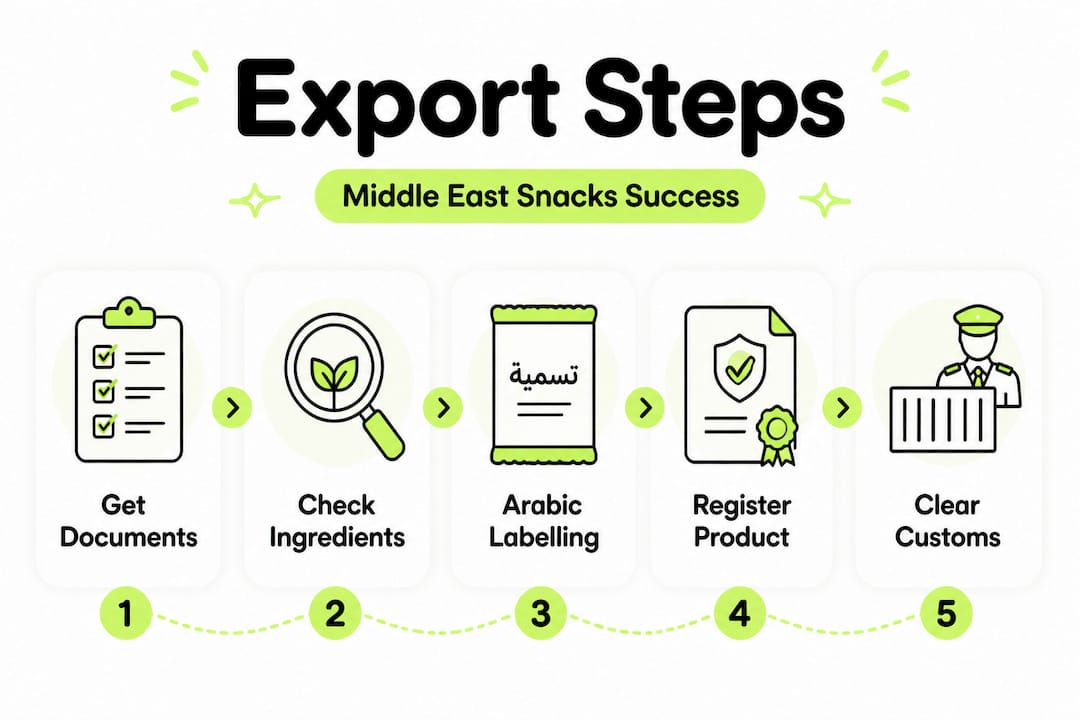
More snack shipments fail at UAE and GCC customs due to labelling errors and missing paperwork than because of poor taste or weak market fit. That reality stops many exporters in their tracks, especially those who’ve invested heavily in product development and flavour innovation. If you’re exploring the Middle East as a destination for gourmet, health-conscious, or vegan snacks, the opportunity is genuinely exciting. But getting your product through the border requires as much rigour in your documentation as it does in your recipe. This article walks you through the compliance essentials, market trends, and strategic pathways you need to know, including common labelling and documentation failure points that trip up even experienced exporters.
Key Takeaways
| Point | Details |
|---|---|
| Get documents right | Accurate documents and certificates are essential to avoid border delays and rejection. |
| Prioritise label compliance | Arabic labels and advance approval are non-negotiable for GCC/UAE entry. |
| Follow HS code rules | Correct HS codes ensure correct tariffs and smooth customs clearance. |
| Leverage UAE as hub | Dubai can serve as your launchpad to access the wider Middle East snack market. |
Opportunities and trends for exporting snacks to the Middle East
The Middle East snack market is going through a real transformation. Health awareness is rising sharply across the UAE, Saudi Arabia, and the wider GCC region, and consumers are actively seeking plant-based, low-calorie, and allergen-conscious options. This isn’t a niche trend any more. It’s a mainstream shift that’s reshaping what sits on supermarket shelves and what gets ordered online.
The Middle East vegan snacks market is growing at a notable pace, driven by younger, urban consumers who are increasingly health-literate and willing to pay a premium for cleaner ingredients. Plant-based snack sales in the UAE grew by double digits in recent years, and demand for products free from artificial additives, refined sugar, and animal-derived ingredients is accelerating. That’s a wave of curiosity that exporters with the right product range can genuinely ride.
Here’s a snapshot of the categories generating the most interest right now:
| Product category | Key driver | Growth indicator |
|---|---|---|
| Vegan popcorn and puffed snacks | Clean label, low calorie | Strong retail and online growth |
| Plant-based protein snacks | Fitness culture, urban youth | Rising gym and wellness culture |
| Asian-inspired flavour snacks | Flavour curiosity, diaspora demand | Premium positioning, gifting appeal |
| Fruit-based snacks | Natural sweetness, health claims | School and family segment growth |
What’s particularly interesting for brands like ours is that flavour innovation plays a huge role. Consumers in the UAE and Saudi Arabia are curious about bold, internationally inspired profiles. Exploring trending snack flavours in 2026 gives you a real sense of how Asian-fusion and tropical profiles are resonating globally, and those same profiles translate well to Middle Eastern palates.
Some of the product attributes that resonate most strongly with health-conscious Middle Eastern consumers include:
- No artificial colours or preservatives
- Vegan and cruelty-free certification
- Allergen transparency on packaging
- Low or no refined sugar
- Natural flavour sources, including spices and botanicals
If you’re building a range with these qualities, you’re already aligned with what the market wants. The challenge, as we’ll explore, is getting that product in front of consumers without falling at the compliance hurdle. Reading about healthy vegan snack ideas and Asian-inspired vegan snacks can help you refine your positioning before you approach regional buyers.
Documentation essentials: What you need to export snacks to the GCC
Knowing why the market is promising, you must next master the necessary paperwork. This is where many exporters stumble, not because the requirements are unreasonable, but because the details matter enormously and small errors compound quickly.

For food imports into the UAE, the importer typically submits core shipping documents and may need an import permit from the relevant competent authority. As the exporter, your role is to ensure every document is accurate, consistent, and ready in advance.
Here are the core documents required for most snack exports into the GCC:
- Commercial invoice with full product description, value, and country of origin
- Certificate of origin issued by an authorised body in the exporting country
- Packing list including HS code, net and gross weight, and number of units
- Bill of entry or bill of lading for sea freight, or airway bill for air freight
- Original health certificate issued by a recognised food safety authority
For products containing meat or animal-derived ingredients, a halal slaughter certificate is also mandatory. For vegan snacks, this requirement typically doesn’t apply, which is one practical advantage of working with plant-based product lines. That said, you’ll still want to document your vegan status clearly, as some authorities may request evidence that no animal derivatives are present.
| Document | Required for all snacks | Required for restricted goods |
|---|---|---|
| Commercial invoice | Yes | Yes |
| Certificate of origin | Yes | Yes |
| Packing list with HS code | Yes | Yes |
| Original health certificate | Yes | Yes |
| Halal slaughter certificate | No | Yes (meat/animal products) |
| Import permit | Sometimes | Yes (specific categories) |
Coordination between exporter and importer is absolutely critical here. The importer in the UAE or GCC is often the one filing documents with customs, but if your paperwork doesn’t match theirs precisely, the shipment stalls. Discrepancies in product descriptions, weights, or HS codes between your commercial invoice and their import declaration are a common cause of delay. Prepare everything well in advance and share drafts with your importer before finalising.
Pro Tip: Always request a pre-shipment review from your importer or a local customs agent. They’ll flag inconsistencies that you simply won’t spot from the exporting country. It’s a small investment that prevents costly amendments at the port.
If you’re developing allergen-sensitive vegan snacks for this market, make sure your health certificate explicitly references allergen management practices. Regional food authorities are increasingly focused on this.
Mastering labelling and product registration: Avoiding the main failure points
Having gathered your documents, the next major hurdle is getting your snack labels and registration right. This is where most new exporters fail. Not dramatically. Quietly. The shipment arrives, gets inspected, and gets rejected or held because a label doesn’t meet requirements.
UAE food labelling rules are clear: labels must be in Arabic, or in both Arabic and English. Production dates and expiry dates must appear on the original manufactured label, not added as stickers after the fact. This catches a lot of exporters off guard, particularly those who produce for multiple markets and apply destination-specific stickers as a shortcut.
The key labelling requirements to get right include:
- Language: Arabic is mandatory; dual Arabic/English is acceptable and recommended
- Date format: Production and expiry dates must be on the original label, not stickered on
- Nutritional information: Must be complete and formatted to regional standards
- Ingredient list: Full declaration including any processing aids
- Country of origin: Clearly stated in Arabic
- Net weight: In metric units (grams or kilograms)
- Health and vegan claims: Must be precise, substantiated, and consistent across all documents
“Advance label approval is strongly recommended; stickers require government approval and must be done before export.” This guidance from the UAE labelling authority is not optional advice. It’s a practical warning that brands ignore at their peril.
Product registration is a separate but related process. In the UAE, food products often need to be registered with the relevant municipality or food safety authority before they can be sold. A mismatch between your registered product details and what’s printed on your label is one of the most common rejection triggers. Even a minor difference in how a flavour is described can cause a hold.
For vegan snack brands, health claims require particular care. Phrases like “100% plant-based,” “no artificial additives,” or “gut-friendly” must be consistent across your label, your registration documents, and your health certificate. Any inconsistency signals a compliance gap. Families looking for healthy vegan snacks are increasingly the core buyer in this region, and your labelling needs to speak to them clearly and accurately.
Pro Tip: Commission a professional Arabic translation from a certified translator with food industry experience, not a general language service. Errors in Arabic labelling are a leading cause of registration rejection and can be expensive to correct once packaging has been printed.
Getting the HS code and duties right for successful entry
After registration, responsibilities don’t end. Your HS code and duties hold the key to smooth customs processing, and getting this wrong creates delays that can spoil time-sensitive food products.
The Harmonised System (HS) code is an internationally standardised numerical classification for traded goods. The first six digits are globally standardised, but destination countries, including Saudi Arabia and other GCC members, add their own digits beyond those six to reflect local duty structures and import restrictions. This means you can’t simply use the same full HS code for every destination.
Here’s a practical framework for getting your HS classification right:
- Identify the correct six-digit HS code for your product category (e.g., popcorn typically falls under 1904 or 2106 depending on preparation and ingredients)
- Check the destination-specific digits with your freight forwarder or a local customs broker in the target country
- Confirm the applicable duty rate for your product under that full code
- Ensure your packing list, commercial invoice, and health certificate all reference the same code consistently
- Review annually as HS codes are updated periodically and duty rates can change
| HS code range | Product type | Typical GCC duty range |
|---|---|---|
| 1904 | Prepared cereals, including popcorn | 5% to 15% |
| 2106 | Food preparations not elsewhere specified | 5% to 20% |
| 2008 | Processed nuts and seeds | 5% to 15% |
Inconsistency between your HS code and the physical product description is a red flag for customs inspectors. If your invoice says “gourmet vegan popcorn” but your HS code points to a different product category, expect questions, delays, and potentially a full inspection. For low-calorie vegan snacks with specific health claims, the classification can sometimes be ambiguous, so it’s worth getting a formal ruling from the destination country’s customs authority before your first shipment.
Pro Tip: Ask your freight forwarder to provide a written HS code recommendation with their reasoning. This protects you if the classification is later questioned at customs, and it forces them to do the work properly rather than guessing.
Using the UAE as your GCC export hub: Practical pathways
Once you’re clear on compliance, Dubai’s status as a regional export hub adds one more competitive advantage. Getting your product into the UAE successfully is genuinely the gateway to the wider GCC.
Onward shipments from the UAE to Saudi Arabia, Bahrain, Qatar, Oman, and Kuwait are a well-established route for international snack brands entering the region. Dubai’s port infrastructure, logistics networks, and free zone ecosystem make it uniquely positioned as a distribution centre for the entire Middle East.
Key advantages of using the UAE as your entry point:
- World-class logistics: Jebel Ali Port is one of the largest container ports globally, with excellent onward connectivity
- Free zones: Areas like the Dubai Multi Commodities Centre (DMCC) and Dubai Airport Free Zone offer streamlined customs processes and favourable tax treatment
- Established import networks: UAE-based distributors often have existing relationships across the GCC
- Consumer testing ground: The UAE’s diverse, cosmopolitan population lets you test product reception before scaling regionally
“The UAE’s free zone infrastructure allows brands to store, repackage, and redistribute goods across the GCC with reduced regulatory friction, provided initial compliance standards are met.”
The critical caveat is that onward shipments to other GCC states still require those countries’ own compliance steps. Saudi Arabia, in particular, has its own food registration requirements that are separate from the UAE’s. Getting your UAE entry right establishes credibility and creates a practical base, but it doesn’t automatically open every door. Working with sustainable snack brands that have already navigated this pathway can offer useful insight into how regional distribution actually works in practice.
Our take: Why compliance mastery, not just great snacks, wins the Middle East market
Here’s the hard truth that most export guides dance around. Brilliant products fail in the Middle East every single year. Not because consumers don’t want them. Not because the price point is wrong. They fail because a label was printed without Arabic text, or because the production date was added as a sticker rather than embossed on the original packaging, or because the HS code on the commercial invoice didn’t match the packing list.
We’ve seen this pattern repeatedly. A brand invests months into developing a genuinely innovative, thoughtfully made vegan snack with real health credentials and exciting flavour profiles. The product is genuinely good. The market genuinely wants it. And then the shipment sits at port because an allergen declaration was worded differently on the health certificate than on the label.
The uncomfortable reality is that compliance isn’t a bureaucratic afterthought. It is the product, as far as customs is concerned. I’d argue that exporters should budget as much time and money for compliance preparation as they do for recipe development and packaging design. That might feel disproportionate, but it reflects what actually determines whether your product reaches consumers.
The brands that succeed long-term in the GCC are those that treat documentation, translation, and registration as a core competency, not an administrative burden to be delegated to the cheapest available option. Build a compliance checklist. Invest in certified Arabic translation. Engage a local customs broker before your first shipment, not after your first rejection. These aren’t optional extras. They’re the foundation.
Discover gourmet vegan snacks ready for the Middle East
For those ready to act, here are gourmet vegan snack solutions primed for this region.
At Popcornaa, we’ve built our range with health-conscious, flavour-curious consumers at the centre of every decision. Our products are entirely plant-based, free from artificial additives, and developed with the kind of bold, internationally inspired flavour profiles that resonate strongly with Middle Eastern consumers.
[ ](https://www.popcornaa.com › pages › asian-fusion-taster-box)
Our vegan popcorn taster box is a practical starting point for importers wanting to sample the range before committing to a larger order. For buyers seeking something with broader gifting and premium retail appeal, our tropical fruit popcorn collection offers a curated selection of Asian-inspired tropical flavours that align beautifully with current regional trends. Explore our full gourmet vegan popcorn range to find the right fit for your market and your buyers.
Frequently asked questions
Which certificates are mandatory to export vegan snacks to the UAE?
You must provide a commercial invoice, certificate of origin, packing list with HS code, bill of entry, and an original health certificate, as core shipping documents are required for all food imports into the UAE.
What are the most common compliance mistakes when exporting snacks to the GCC?
The most frequent mistakes are incorrect or missing Arabic labelling, date formatting issues, and missing document registration, all of which are common shipment-failure points for GCC-bound exports.
How does the HS code affect snack import duties in Saudi Arabia?
Duties and restrictions are determined by HS code; Saudi Arabia requires specific digits beyond the standard six, as destination-specific digits differ from the globally standardised first six.
Can the UAE act as a gateway for snack exports to other GCC countries?
Yes, Dubai serves as a strategic export hub for onward shipments to all GCC states if all compliance steps are met, including Saudi Arabia, Bahrain, Qatar, Oman, and Kuwait.
Is advance label approval necessary for every snack export?
Advance label approval is strongly recommended to avoid shipment rejections, as UAE labelling requirements mandate that production and expiry dates appear on the original manufactured label, not added as stickers.