

Kosher vegan snacks: custom options and what to know
TL;DR:
- Vegan does not automatically mean a snack is kosher due to differing food laws.
- Genuine kosher certification involves ongoing inspection of ingredients, equipment, and manufacturing processes.
- Transparency and label verification are essential for trusting kosher vegan snack claims.
There’s a moment that stops you in your tracks. You’re standing in a snack aisle, or scrolling through an online shop, and you spot something labelled “100% vegan” and assume it ticks every box on your list. But if kosher compliance matters to you, that assumption can quietly let you down. The relationship between vegan and kosher is genuinely fascinating, and far more layered than most people realise. Understanding it opens up a smarter, more satisfying way to snack, especially when you’re after gourmet flavours, bespoke mixes, and genuine dietary integrity all in one place.
Key Takeaways
| Point | Details |
|---|---|
| Certification clarity | Only snacks with official kosher certification fully comply—vegan status alone is not enough. |
| Customisation enabled | Many manufacturers now offer bespoke format and flavour solutions, carefully maintaining kosher oversight. |
| Label literacy is key | Always check each SKU’s packaging for kosher symbols to avoid hidden risks in seemingly healthy or vegan snacks. |
| Supply chain diligence | Ingredient-level verification is crucial when customising gourmet snacks under kosher supervision. |
| Choose transparent brands | Trust brands that share their kosher process openly and let you customise your own snack mix. |
What makes a snack truly kosher?
Now that we’ve introduced the complexities behind kosher and vegan snacks, let’s clarify what “kosher” means in practice. The word itself comes from Hebrew, meaning “fit” or “proper.” But in the food world, it refers to a detailed set of dietary laws rooted in Jewish tradition, covering everything from which ingredients are permitted to how equipment is cleaned between production runs.

Here’s the part that surprises many people. A snack being vegan does not automatically make it kosher. A product could be entirely plant-based and still fail kosher standards. Why? Because kosher law goes beyond ingredients. It also governs how food is produced, what equipment it shares, and whether any non-kosher substances have come into contact with it during manufacturing.
This is exactly why third-party kosher certification matters so much. It involves independent oversight of the facility, the production process, and the labelling itself. Without that external check, a brand’s own claim of being “kosher style” or “naturally kosher” carries very little weight. “Kosher style” is not kosher. It’s a marketing phrase, and a misleading one at that.
For those shopping for vegan snacks for allergen-sensitive diets, this distinction matters enormously. Kosher certification adds a layer of supply chain scrutiny that many allergen-conscious consumers actually find reassuring, even if they’re not observing Jewish dietary law themselves.
Key criteria for kosher snack status:
- The product must carry a recognised kosher certification symbol from an accredited body
- All ingredients, including flavourings and additives, must be individually kosher-verified
- Equipment used in production must not have been used for non-kosher foods without proper cleaning
- Dairy and meat products must be kept entirely separate (pareve status means neither)
- The facility must be subject to periodic inspection by the certifying authority
“Kosher certification is not a one-time stamp. It’s an ongoing relationship between the brand, the facility, and the certifying body. Every ingredient change, every new supplier, every production tweak needs to be re-evaluated.”
That level of rigour is what separates genuine kosher certification from surface-level claims. And for snack lovers who care about what’s really in their food, it’s genuinely reassuring.
Customisation and innovation in kosher snack manufacturing
With kosher certification explained, it’s important to see how snack makers keep pace with rapidly changing tastes. The snack industry has shifted dramatically. Consumers want bold flavours, clean labels, non-GMO ingredients, and dietary compliance, all at once. For kosher manufacturers, meeting those expectations while maintaining certification is a real balancing act.
The good news is that innovation and kosher compliance are not mutually exclusive. In fact, some of the most exciting flavour development happening right now is taking place within kosher-certified facilities. Companies like Flavor House have built entire R&D frameworks specifically designed to support custom kosher snack solutions, including HACCP food safety protocols, vegan claims, and on-site laboratories where new flavours are developed and tested under certification.
HACCP stands for Hazard Analysis and Critical Control Points. It’s a systematic approach to food safety that identifies where contamination risks exist and puts controls in place at each of those points. For kosher manufacturers, HACCP and kosher compliance often reinforce each other, because both demand meticulous documentation and process control.
Understanding why gourmet popcorn matters helps put this into context. Gourmet snacking isn’t just about taste. It’s about trust. Consumers want to know that the brand behind their snack has thought carefully about every step of the process, from sourcing to seasoning to shelf life.
Pro Tip: When placing a custom snack order with any manufacturer, always ask whether kosher oversight applies end-to-end, including to any new flavours or ingredients added to your bespoke mix. A single non-certified additive can compromise the entire product’s status.
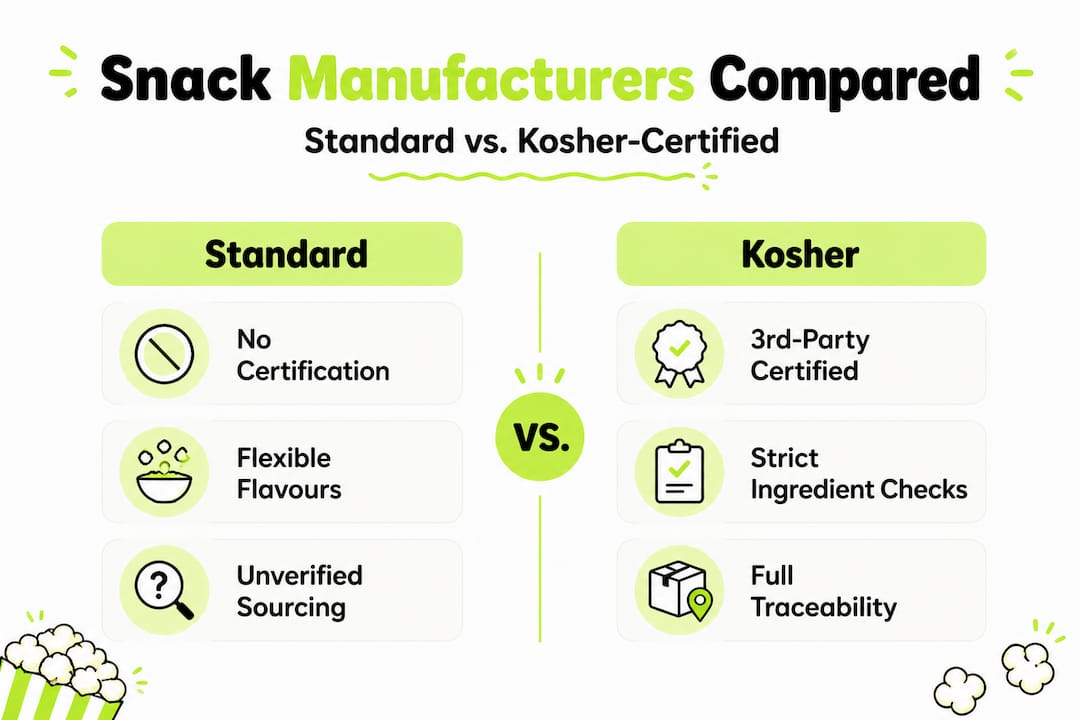
| Feature | Standard snack manufacturer | Kosher-certified custom manufacturer |
|---|---|---|
| Third-party certification | Rarely required | Mandatory for kosher claim |
| Custom flavour R&D | Common | Available, with certification oversight |
| Vegan ingredient sourcing | Optional | Often integrated with kosher sourcing |
| HACCP compliance | Varies | Standard practice |
| Ingredient transparency | Inconsistent | Documented per production run |
Knowing what makes popcorn gourmet is partly about understanding this infrastructure. Gourmet isn’t just a flavour profile. It’s a commitment to quality at every stage, and kosher certification is one of the most rigorous quality signals a snack brand can carry.
Tailor-made: exploring build-your-own and bespoke kosher snack solutions
Besides manufacturer-led innovation, consumers themselves are shaping snack choices through customisation. The build-your-own snack model has grown significantly, and it’s particularly exciting within the kosher vegan space because it puts real choice back in the hands of the person doing the snacking.
Brands like Taffy Town have long offered custom confectionery mixes where customers select their own flavour combinations. In the savoury snack world, companies such as JR Short offer custom kosher pellet formats and batch processing options that allow brands to create entirely bespoke snack products while maintaining kosher compliance throughout. Craft jerky brands have also entered this space, offering kosher-certified, plant-based jerky mixes that can be tailored to specific flavour preferences.
The custom popcorn creation process follows a similar logic. It starts with a base, then layers in flavour, texture, and dietary requirements, all while keeping certification intact.
How to customise a kosher snack box step by step:
- Start by identifying your dietary requirements clearly: kosher pareve, vegan, gluten-free, or a combination
- Choose a brand or platform that explicitly states kosher certification for all products in their range
- Select your base snack format, whether that’s popcorn, pretzels, crisps, or a mix
- Add flavour profiles one at a time, confirming each is certified individually
- Check the final packaging for the kosher symbol before completing your order
- If ordering in bulk or as a gift, request a product specification sheet from the brand
Understanding best popcorn flavours can help you make more confident choices at each of these steps, especially when you’re mixing bold Asian-inspired seasonings with more familiar British flavour profiles.
| Brand/model | Kosher certified | Vegan options | Build-your-own | Custom batch |
|---|---|---|---|---|
| Taffy Town | Yes | Yes | Yes | Limited |
| JR Short | Yes | Yes | No | Yes |
| Craft jerky brands | Varies | Yes | Some | No |
| Popcornaa | Yes | Yes | Yes | Yes |
What to check on packaging for both vegan and kosher guarantees:
- A recognised kosher symbol such as OU, OK, or KF
- Clear “vegan” labelling, ideally certified by an independent body
- An ingredient list with no ambiguous animal derivatives
- Allergen information that confirms no cross-contamination with dairy or meat
- A batch or lot number, which indicates proper traceability
Behind the label: why checking each snack for real kosher status matters
Even with customisation and innovation, upholding kosher standards comes down to precise label verification. This is where many well-meaning snack lovers get caught out. They spot a brand they trust, see the word “vegan” in large letters, and assume the rest follows. It doesn’t always.
Kosher law divides food into three categories: meat, dairy, and pareve. Pareve means the product contains neither meat nor dairy, and it’s the category most relevant to plant-based snackers. A pareve kosher snack is compatible with both meat and dairy meals, which makes it the most flexible option. But here’s the thing: even a pareve product can lose that status if it’s produced on equipment shared with dairy items without proper cleaning.
Many vegan snack brands are kosher only for certain products in their range, not across the board. A brand might offer twenty flavours, but only twelve carry the kosher symbol. The other eight might use a flavouring or colouring that hasn’t been certified. This is why you must check the kosher symbol per individual SKU, not just per brand.
Sub-ingredient sourcing is another complexity. When a manufacturer creates a custom flavour, they draw on a supply chain of individual components: spice blends, natural flavourings, emulsifiers, colourings. Each of those components needs its own kosher verification. As supply chain certification becomes more central to kosher compliance, brands doing custom work face a genuinely demanding documentation challenge.
Exploring healthy gourmet vegan snacks is much more rewarding when you know what to look for. And vegan gourmet popcorn explained gives a solid grounding in how quality plant-based snacks are made, which helps you read labels with more confidence.
Red flags and best practices in label reading:
- No kosher symbol at all, even on a product claiming to be “naturally kosher”
- A kosher symbol that is unfamiliar or not from a widely recognised certifying body
- Vague ingredient descriptions like “natural flavour” without clarification
- No allergen information or cross-contamination warning
- A brand claiming kosher status across the range without per-product verification
Pro Tip: Look for both a recognised third-party kosher mark and a full ingredient list with transparent sourcing notes. The two together are far more reassuring than either one alone.
Our perspective: the future of kosher vegan snacking is built on choice, trust, and transparency
Pulling together the practical and technical sides of custom kosher snacking reveals a broader industry vision. And honestly, it’s one I find genuinely exciting.
Most shoppers never realise how much is happening behind the scenes before a snack reaches their hands. There’s R&D, supply chain vetting, facility inspections, ingredient-by-ingredient certification checks, and ongoing compliance monitoring. It’s a lot. And yet, when it works well, the consumer experience feels effortless. You pick up a bag, see the symbol, and trust it. That trust is hard-won and fragile.
What I believe, from everything I’ve seen in this space, is that the brands which will genuinely win over the next generation of health-conscious, flavour-curious snack lovers are the ones that make their process visible. Not in a boastful way, but in a “here’s exactly what went into this bag” kind of way. Build-your-own models are a brilliant expression of this. When you let a customer choose their flavours, their mix, their format, you’re implicitly saying: we’re confident enough in our process to let you look inside it.
The danger of relying on surface health or vegan branding without label literacy is real. I’ve seen it firsthand. A product looks the part. It’s in beautiful packaging, it’s got a wellness-forward name, and it’s stocked next to all the right things. But the kosher symbol is missing, or it’s there for only one variant in the range. That gap between appearance and reality is where trust breaks down.
The snack lovers I most respect are the ones who’ve become label detectives. They reward brands that show their working, that let you trace an ingredient back to its source, that update their certification information when things change. That’s the standard worth holding. Exploring how private label popcorn suppliers approach transparency gives a useful window into how the best operators in this space think about accountability.
The future of kosher vegan snacking isn’t just about more flavours or bigger ranges. It’s about deeper honesty between brands and the people who eat their products. That’s the kind of snacking culture worth building.
Explore your next kosher gourmet snack adventure
If you’re ready for gourmet, trustworthy snacking that doesn’t compromise on choice or standards, here’s where to start.
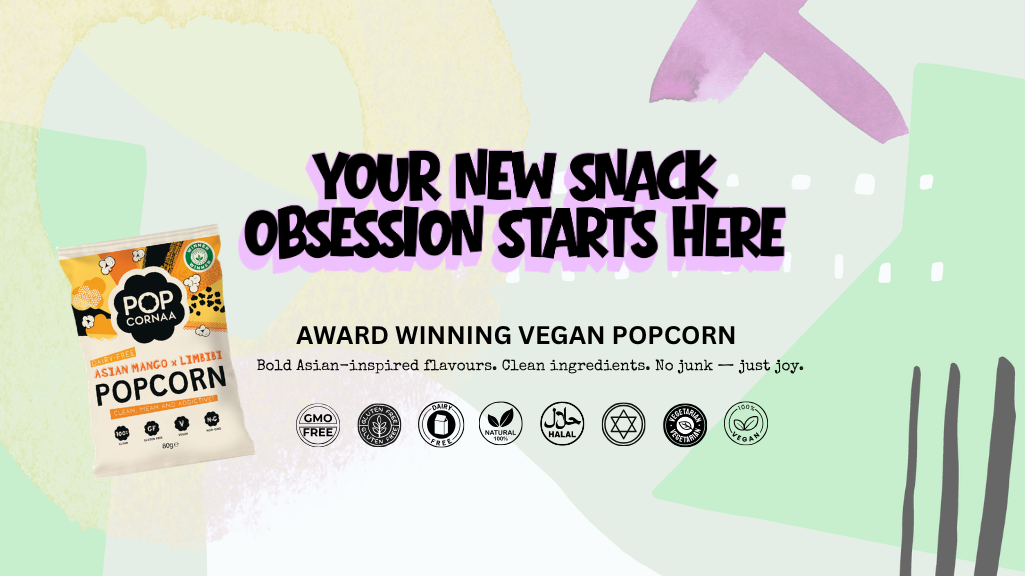
At Popcornaa, we’ve built our entire range around the idea that bold flavour and genuine dietary integrity belong together. Every product is vegan, and our commitment to transparency means you always know what you’re getting.
[ ](https://www.popcornaa.com › pages › asian-fusion-taster-box)
Whether you want to build your own vegan snack pack from scratch, discover something new with our Asian Fusion Taster Box, or explore our award-winning popcorn flavours that have earned recognition for genuine quality, there’s a starting point here for every kind of snack enthusiast. The labels are clear, the flavours are real, and the choice is entirely yours.
Frequently asked questions
How do I confirm if a snack is truly kosher and vegan?
Check for an official kosher certification symbol on each individual pack, because kosher status per SKU cannot be assumed from vegan labelling alone. Vegan and kosher are separate standards with different requirements.
What does third-party kosher certification actually involve?
It requires an independent authority to inspect the facility, verify ingredients, and oversee the production process before granting the brand permission to use a recognised kosher mark. This ongoing relationship is what makes the certification meaningful.
Are custom snack mixes from kosher manufacturers always certified kosher?
Only if every individual flavour component and additive has been separately verified, so always check the packaging or ask the manufacturer directly. As Flavor House demonstrates, custom production and kosher compliance can coexist, but only with rigorous ingredient-level oversight.
Why do ingredient supply chains matter so much for kosher snacks?
Every ingredient and additive in a custom snack must be individually kosher-verified, because a single uncertified component can compromise the entire product. Supply-chain documentation is therefore central to any manufacturer doing bespoke flavour work.
What common problems should I look out for when shopping for kosher vegan snacks?
Watch for missing or unfamiliar kosher symbols, vague ingredient descriptions, and brands that claim kosher status across a whole range without per-product verification. Trendy vegan branding can sometimes obscure the absence of genuine certification.