

6 Popcorn Flavor Types With Vegan, Gourmet Kernel and Seasoning Tips
Popcorn flavours fall into six broad families: sweet, salty, savoury, spicy, umami-gourmet and seasonal or novelty blends, each built on a different balance of fat, sugar, salt and aroma. This guide walks through recognisable examples in each family, twelve ready-to-copy recipes, the seasoning technique that makes coatings stick properly, and how kernel choice changes the outcome. The guide includes practical details on gourmet vegan popcorn with Asian-inspired and British flavours.
TL;DR:
- Seasonings should be applied after popping, using oil or a sugar slurry as a binder to ensure flavors cling and do not burn during cooking.
- Kernel type influences flavor application: butterfly kernels suit delicate coatings, while mushroom kernels are better for heavy, thick coatings like caramel or cheese.
- Fine-milled salts and dry spices mixed with oil or clarified butter create the most even coating, enhancing crispness and flavor retention.
- Popular flavor families include sweet, salty, savory, spicy, umami-gourmet, and seasonal blends, each with specific ingredient and technique considerations.
- Most high-preference popcorn flavors like buttered, salted, and spiced blends are simple to execute at home with proper seasoning and kernel choices.
Types of popcorn flavours: the six main categories
Every popcorn flavour you have ever eaten belongs to one of six families, and knowing which one you are working with tells you what binder and technique to reach for before you even open the spice cupboard.
Sweet flavours lean on sugar, butter and caramelisation. Think classic caramel corn, cinnamon sugar, salted caramel, or a maple pecan mix. Swap dairy butter for a vegan block butter and use coconut sugar in place of brown sugar for a deeper, almost toffee-like glaze that still caramelises properly.
Salty flavours are the baseline everyone recognises: classic buttered popcorn, sea salt, and simple salt-and-vinegar blends built on citric acid powder rather than actual vinegar (which turns kernels soggy).
Savoury flavours bring cheese, herbs and umami without heat. Cheddar, Parmesan, ranch, and nutritional yeast “cheesy” blends sit here. Nutritional yeast is the standard vegan stand-in for Parmesan or cheddar powder, and it clings well to an oil-misted kernel.
Spicy flavours range from a gentle chilli-lime dusting to genuinely hot Nashville-style cayenne blends. Smoked paprika, chipotle, and sriracha powder all belong in this category, and most work best mixed into a fine dry rub rather than a wet drizzle.
Umami and gourmet flavours are where popcorn stops being a snack and starts being a small plate: truffle, miso caramel, furikake, or balsamic reduction with vegan Parmesan. These rely on concentrated, savoury aroma compounds rather than raw heat or sugar.
Seasonal and novelty flavours rotate with the calendar: pumpkin spice in autumn, peppermint bark at Christmas, or birthday-cake popcorn for parties. They borrow techniques from the sweet family but lean on a signature spice or extract to feel distinct.
A few reliable examples across the range:
- Sweet: salted caramel, cinnamon sugar, maple pecan
- Salty: sea salt and cracked pepper, classic butter, salt and vinegar
- Savoury: vegan Parmesan and herb, smoky cheddar, ranch
- Spicy: chilli-lime, Nashville hot, smoked chipotle
- Umami/gourmet: truffle and vegan Parmesan, miso caramel, furikake
- Seasonal/novelty: pumpkin spice, peppermint bark, birthday cake
For a deeper breakdown of how these profiles are built, Popcornaa’s guide to popcorn flavour profiles for home cooks walks through the ratios in more detail.
16 popular popcorn flavour combinations worth trying
These are the flavour builds that come up again and again in gourmet popcorn menus and home-cooking forums, each with a one-line method note so you can start immediately.
- Classic butter — melt vegan butter, drizzle over hot popcorn in three passes, tossing between each.
- Sea salt and cracked pepper — finely grind both together so neither pools at the bottom of the bowl.
- Salted caramel — cook sugar to a deep amber (around 170°C), stir in vegan butter and a pinch of sea salt, then pour thinly over popcorn and toss fast before it sets.
- Cinnamon sugar — mix caster sugar with ground cinnamon, toss with warm popcorn coated lightly in neutral oil.
- Cheese and Parmesan style — combine nutritional yeast, fine salt and a touch of onion powder; works best on an oil-misted base.
- Chilli-lime — blend chilli powder, citric acid and lime zest, then dust over oil-coated popcorn immediately after popping.
- Matcha white chocolate — melt vegan white chocolate, whisk in matcha powder, drizzle thinly and let it set before serving.
- Tandoori masala — mix tandoori spice blend with a little smoked paprika and salt; a dry rub, no oil needed if kernels are freshly popped and warm.
- Modena balsamic and vegan Parmesan — reduce balsamic vinegar until syrupy, drizzle sparingly, then dust with nutritional-yeast Parmesan.
- Furikake — toss warm popcorn with a light sesame oil mist, then sprinkle furikake generously.
- Smoked chipotle and lime — combine chipotle powder, lime zest and salt for a dry rub with real depth.
- Elite-style — chilli powder, lime, and a vegan “cotija” of nutritional yeast and a little extra salt, inspired by Mexican street corn (Spicewalla’s take on this pairing is worth a look for ratios).
- Truffle and vegan Parmesan — a few drops of truffle oil, tossed thoroughly, then a fine Parmesan-style dusting.
- Ranch — dried dill, garlic powder, onion powder and a little nutritional yeast for the tang.
- Peppermint bark — melted vegan dark chocolate drizzle, crushed candy cane on top, left to set fully before breaking apart.
- Za’atar — sesame seeds, sumac, dried thyme and salt, tossed with a light olive oil mist for a Middle Eastern-leaning savoury profile.
Notice the pattern: sweet builds almost always need a drizzle or slurry that sets, while dry spice blends need an oil or fat base first so the powder actually clings. Popcornaa’s seasoning recipe guide for vegan flavour mixes covers several of these ratios in more depth.
How to season popcorn so the flavour actually sticks
Most seasoning failures come down to one mistake: applying a coarse spice blend to dry popcorn with no binder. Salt and spice granules are too heavy to cling to a dry, porous flake, so they fall straight to the bottom of the bowl.
Post-pop seasoning is the standard approach for good reason. Home popper heat is enough to scorch delicate spices before the corn has even finished popping, so most seasoning guides recommend applying flavour after popping, with heat-stable ingredients like whole spices in the popping oil as the only real exception. Industrial producers use pre-seasoning techniques that achieve much higher flavour retention on the kernel hull than a home cook could replicate with a stovetop pot, so don’t expect a pre-seeded batch at home to taste like a packet from the shop.
The binder matters as much as the seasoning itself:
- Neutral oil or oil mister — light coating, ideal for dry spice rubs and savoury blends.
- Clarified butter (ghee) — removing the milk solids stops the popcorn turning soggy, and it holds crispness far longer than whole butter.
- Sugar slurry — a thin sugar-and-water syrup cooked briefly, used for kettle corn and light sweet coatings.
- Caramel or chocolate drizzle — for the heavier sweet builds like salted caramel or peppermint bark.
Pro Tip: Grind your salt and spices to a fine, almost flour-like texture before tossing them with popcorn. Professional kitchens call this “floursalt,” and the fine grain clings to an oil-misted kernel far more evenly than coarse flakes, which just roll to the bottom of the bowl.
If your popcorn turns soggy, you have used too much wet binder for the batch size. If your spices taste burnt, they went into the pot before popping rather than after. Both are fixable by adjusting quantity and timing rather than the recipe itself.
Kernel and flake type: does it really change the flavour?
Yes, and this is the step most home cooks skip entirely. Popcorn kernels pop into one of two shapes: butterfly, which is irregular and wing-like, or mushroom, which is round and dense. Kernel shape and size directly affect how much a kernel expands, how the flake holds its shape, and how well it carries a coating.
Butterfly kernels are lighter and airier, which makes them better suited to delicate glazes, fine spice dustings, and anything where you want the seasoning to coat rather than smother. Mushroom kernels are denser and hold up better under heavy caramel, thick cheese coatings, or anything poured rather than dusted, because the flake structure resists collapsing under the weight. Smaller kernels tend to produce more tender flakes with fewer tough hulls, while larger ones give the showier, concession-stand look but with a chewier bite.
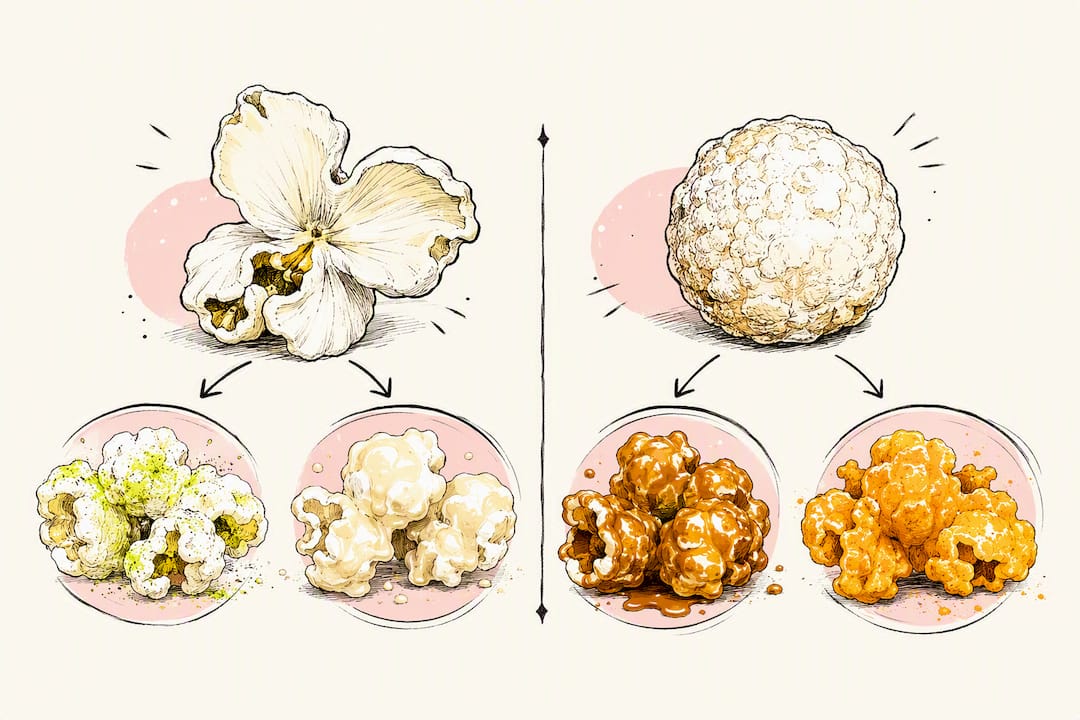
Match the kernel to the coating before you start: heavy pour, go mushroom; light dust, go butterfly.
An approach to gourmet vegan popcorn flavours
The range builds around pairing the right flavour family with the right technique rather than treating popcorn as one generic base. The collections split between Asian-inspired flavours and British-leaning ones, featuring options like furikake and matcha alongside cheddar and salt-and-vinegar flavours, all made without animal products.
Taster selections and curated snack mixes are available for readers wanting to test flavour families before committing to a full order. A flavour quiz also helps narrow down preferences before browsing the full range. For more technical background on why certain pairings work, the popcorn flavour science article and the full flavour checklist are both worth a read.
Nutritional considerations across different popcorn flavours
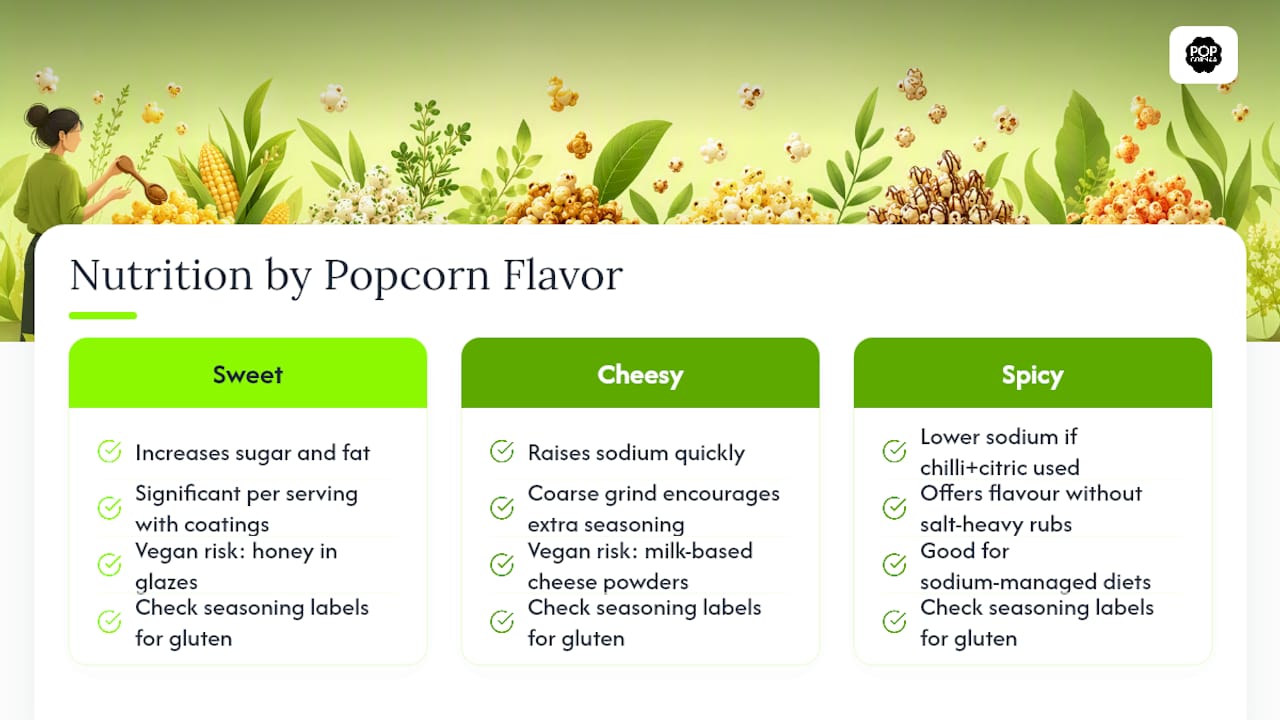
Plain, air-popped popcorn is naturally low in calories and a genuine source of fibre, but every flavour you add changes that profile, sometimes dramatically. A sweet caramel or chocolate-drizzle coating adds significant sugar and fat per serving, while a savoury cheese-style blend adds sodium fast, especially if you are seasoning generously to compensate for a coarse grind.
For anyone managing sodium intake, fine-milled salt actually helps: because it clings more evenly to the kernel, you often need less of it to get the same perceived saltiness compared with a coarse, unevenly distributed sprinkle. Spicy blends built from dried chilli and citric acid rather than salt-heavy rubs are a reasonable way to get flavour intensity without the sodium load.
Dietary restrictions matter just as much as calorie counts. Vegan cooks should watch for dairy butter, milk-based cheese powders, and honey in glazes, all easily swapped for plant-based butter, nutritional yeast, and maple or agave syrup. Gluten is rarely an issue with plain popcorn itself, but flavoured coatings and pre-mixed seasoning blends sometimes contain wheat-based anti-caking agents, so it is worth checking labels on packaged seasoning mixes rather than assuming popcorn is automatically gluten-free once flavoured.
Why most popcorn seasoning advice undersells the technique
The flavour itself gets all the attention in most recipe roundups, and the technique gets treated as an afterthought. That is backwards. A truffle and Parmesan blend on the wrong kernel, applied without a binder, tastes worse than plain salted popcorn made properly. The research on volatile aroma compounds backs this up: popcorn’s own aroma comes from a surprisingly small set of key compounds, which means the base pop matters more to overall flavour than most people assume, and a bad base will fight against even a well-made coating.
Sensory research also suggests something the flavour lists rarely mention: buttered popcorn consistently scores highest for overall acceptability in panel testing, ahead of more elaborate savoury and spiced blends. That is not an argument against ambitious flavours. It is a reminder that a properly executed simple flavour will usually beat an ambitious one made carelessly.
If you take one thing from this guide, prioritise the binder and the kernel choice before you obsess over the seasoning blend itself. Everything else follows from getting those two right.
— Emily
Where to find these flavours already made
For those looking to save kitchen time, taster selections are offered that are vegan, balanced between Asian-inspired and British-leaning profiles, and seasoned by experienced flavour developers. These suit anyone wanting to compare several flavour families side by side before committing to a full-size bag of any single one.
[ ](https://www.popcornaa.com › pages › asian-fusion-taster-box)
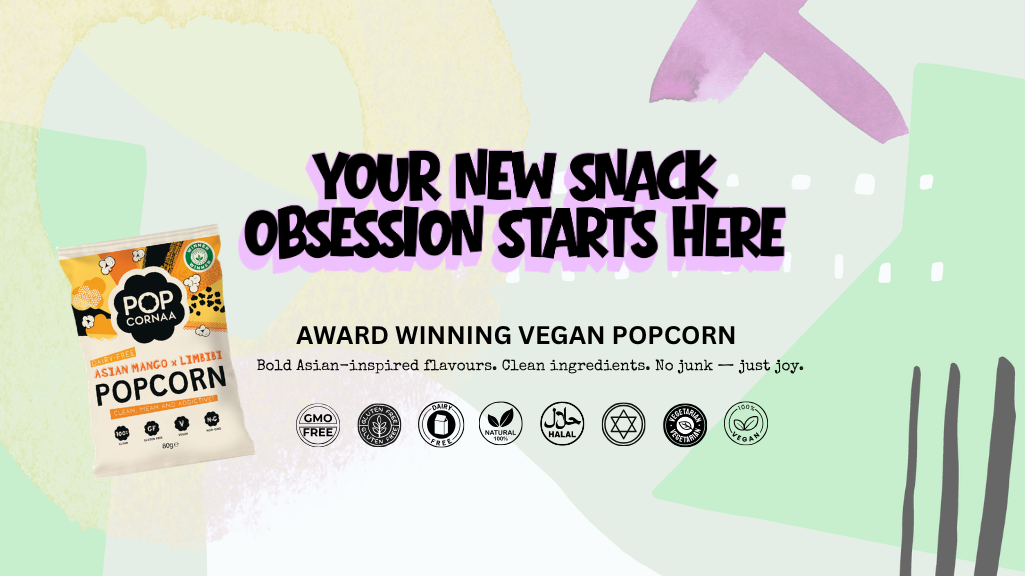
The Newbie Asian Fusion Taster Box is built exactly for readers at this stage: five bags, five flavour directions, no need to guess which family suits your palate before you buy in bulk. If you have just read through savoury, spicy and umami builds and are not sure which one you would actually reach for first, that taster box answers the question in one order rather than five separate experiments.
Sources
- Development of Value-Added Flavored Popcorn and Its Sensory Evaluation
- Popcorn flavor: identification of volatile compounds | Journal of Agricultural and Food Chemistry
- Comparison of sensory properties of popcorn from various types and sizes of kernel
- Serious Eats — Popcorn seasoning tips
FAQ
What are the top popcorn flavours people actually buy?
Buttered and salted popcorn consistently rank highest in taste-preference research, with savoury spiced blends like mix masala close behind, according to sensory panel testing. Beyond those, cheese, caramel, chilli-lime and truffle blends are the most commonly reordered gourmet flavours.
What are the best flavourings for popcorn?
Fine-milled salts and spices paired with a thin fat binder, such as clarified butter or an oil mister, give the most even coating and the best crispness. For sweet builds, a cooked sugar slurry or drizzle works better than dry sugar alone.
How many types of popcorn flavours are there?
There is no fixed number, but flavours generally group into six recognisable families: sweet, salty, savoury, spicy, umami-gourmet, and seasonal or novelty. Within those families, dozens of specific recipes exist, from classic butter to matcha white chocolate.
Does the type of popcorn kernel change how a flavour tastes?
Yes. Butterfly kernels suit light glazes and fine spice dustings, while denser mushroom kernels hold up better under heavy caramel or thick cheese coatings without collapsing.
Should I season popcorn before or after popping?
Season after popping in almost every home situation, because most dried spices burn or turn bitter under popper heat. Heat-stable whole spices added to the popping oil are the main exception.