
Vegan snack industry terms: a plain-English guide to labels
The words on a snack bag look like they all say the same thing, but they do not. “Vegan”, “plant-based”, “dairy-free”, “natural”, “clean label” and “allergen-friendly” are used by brands, regulators and certification bodies in different ways, and in the UK only some of them are tied to anything you can check. This guide explains each term, what it promises and what it leaves open, so you can read any pack in under a minute. At PopCornaa we make gourmet vegan popcorn with Asian-inspired and British flavours, and these are the terms our customers ask us about most.
TL;DR
- There is no legal definition of “vegan” in UK law. A vegan claim means no animal-origin ingredients were intentionally used, and the business must not mislead you.
- “Plant-based” is looser than “vegan”. It can describe a product that is mostly plants but still contains an animal ingredient such as egg or honey.
- “Vegan” and “allergen-free” are separate claims. A vegan label is not a safety statement for someone with a milk or egg allergy, so always read the allergen information.
- Certification marks such as the V-Label and the Vegan Society trademark check the recipe and the production process, which an ingredient list alone cannot show.
- Terms like “natural” and “clean label” describe a brand’s approach, not a legal or certified standard.
Vegan and plant-based: the two terms that get mixed up
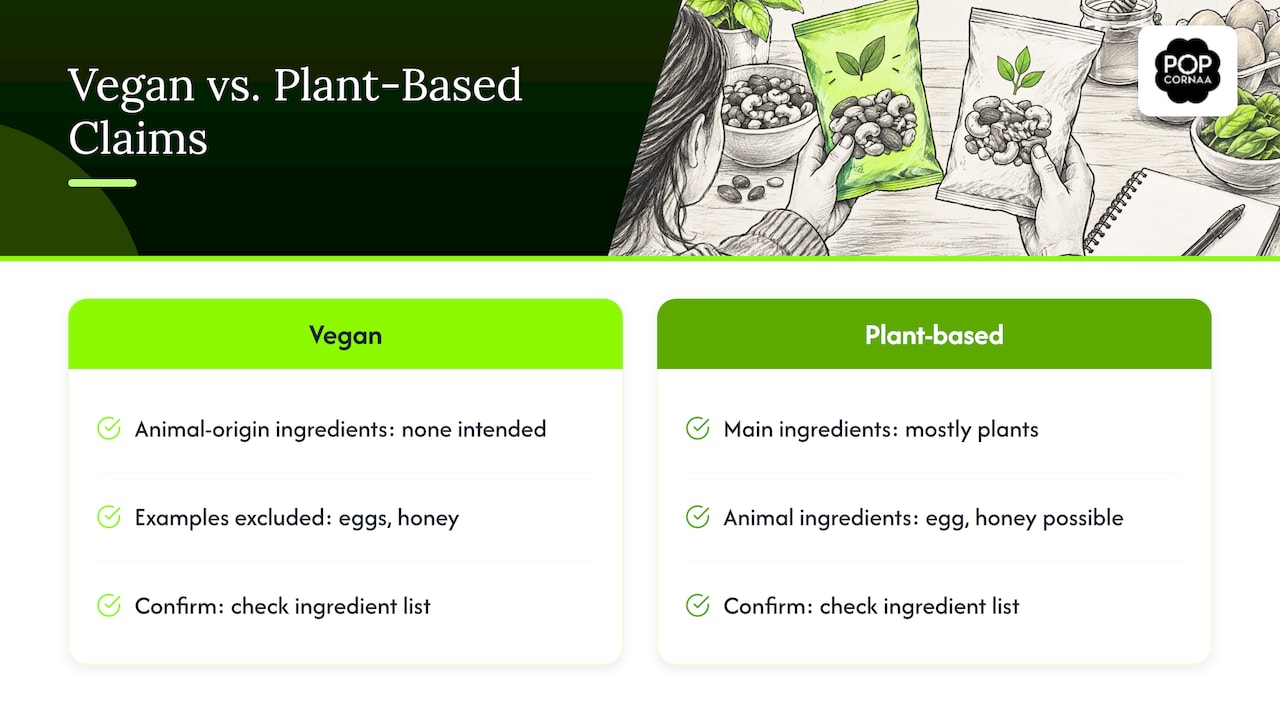
Vegan is the stricter word. According to GOV.UK’s guidance on vegan food labelling, there is no legal definition of vegan food in UK law, but businesses must label food accurately and not mislead. In practice, a vegan label means no ingredients of animal origin were intentionally used. Dietitians at Northwell Health describe vegan food as containing no animal products or byproducts: no meat, fish, dairy or eggs, and no animal-derived ingredients such as gelatin, honey or certain enzymes.
Plant-based is the looser word. The same Northwell guide explains that it typically means mostly made from plants, and may still include animal ingredients. Their examples are a plant-based burger bound with egg, or a non-dairy yogurt sweetened with honey. An academic review of vegan and plant-based claims makes the same point: plant-based foods can be formulated for vegetarian or flexitarian diets and do not, by definition, exclude animal ingredients.
The practical rule: treat “plant-based” as a clue and “vegan” as a claim. Both are starting points, and the ingredient list is where you confirm them. If you want to see how the two words differ in a food context, this piece on telling plant-based and vegan products apart walks through checking ingredients.
Why there is no single legal answer
The gap is not only a UK matter. The European Court of Auditors reported in September 2024 that no EU rules define “vegan” or “vegetarian” or set trace thresholds, and that companies can voluntarily follow ISO 23662:2021 or a private certification scheme. That ISO standard, published in 2021, sets definitions and technical criteria for foods suitable for vegetarians or vegans, and applies to labelling and the food trade. It is a voluntary reference, not a law.
For you, this means the quality of a vegan claim depends on the brand and, where there is one, on the certifier behind the logo.
Dairy-free, egg-free, free-from: related but not the same
These terms narrow things down to a single ingredient group, and that is exactly why they do not equal vegan.
| Term | What it says | What it does not say |
|---|---|---|
| Vegan | No animal-origin ingredients intentionally used | That the product is safe for an allergy |
| Plant-based | Made mainly from plants | That it has no animal ingredients |
| Dairy-free | No milk or milk-based products | That it has no egg, honey or gelatine |
| Egg-free | No egg ingredients | That it has no milk or honey |
| Allergen-free (free-from) | A food-safety claim about a named allergen | That the product suits a vegan diet |
The Food and Drink Federation (the UK food industry body) is clear in its guidance on allergen-free and vegan claims that the two are separate claims for different consumer groups. “Dairy” refers only to milk and milk-based products, so a dairy-free product may still include egg. A “free-from” claim is an absolute claim, and the guidance says it needs a rigorous risk assessment of the whole supply chain plus testing of the finished product.
That last point is why we describe our own approach in specific terms. All PopCornaa products are vegan and made with clean, natural ingredients, and our facility is free of major allergens. We say both things because they answer two different questions a shopper asks: “is it vegan?” and “is it safe for my family?”.
“Natural”, “clean label” and “allergen-friendly”
These three phrases appear on a great many snack bags and they are the most marketing-led terms in the aisle.
- Natural usually signals that a brand avoids artificial additives. It is not a promise about animal ingredients: Northwell’s dietitians list “natural flavors” among the vague label terms where the source is not stated.
- Clean label is an industry phrase for short, recognisable ingredient lists. It is a brand philosophy rather than a certified standard.
- Allergen-friendly is a descriptive phrase, not a regulated claim. What matters is the specific statement behind it: which allergens, and how the maker controls them.
When you see any of these, flip the pack over. A short ingredient list is the reason clean-label products are easy to check, because there are fewer places for something unexpected to hide.
Animal ingredients that hide in snacks
Most snack mistakes happen with ingredients you would not expect, not the obvious ones. Northwell’s label guide lists the common culprits to scan for:
- gelatin, from animal collagen, found in sweets and marshmallows;
- whey or casein, the milk proteins, in bars and baked goods;
- honey, often used as a binder in bars and cereals;
- lard or tallow in pastry;
- shellac, carmine and isinglass, a glaze, a red dye and a fish-derived fining agent.
The same guide flags vague terms: “natural flavors”, enzymes that are sometimes animal-based, and vitamin D3, which is often made from lanolin (sheep’s wool). Its advice is to check the start and end of the ingredient list, where small but significant additives tend to sit.
Savoury snacks have their own traps. Flavoured crisps can use milk powder, whey or cheese powder, and sweet bars can use honey or milk-chocolate coatings. If you buy flavoured popcorn, the seasoning is where to look, since the corn itself is a plain plant food.
Reading E-numbers
In the UK, additives appear with E-numbers, and some are famously ambiguous. Carmine is E120, shellac is E904 and beeswax is E901. Emulsifiers such as E471 can come from plant or animal fats, so the number alone does not tell you the source. That ambiguity is one reason certification marks exist.
What vegan certification marks actually check
An ingredient list shows what was added to the recipe. It rarely shows processing aids, the helper substances used during production. The V-Label FAQ explains that E-numbers are unfamiliar to most shoppers, some ingredients need not be declared, many can be plant or animal variants, and processing aids are usually not listed. Licensed products are therefore checked on composition and on every production step, with independent audits, and any recipe or process change has to be reported.
The V-Label criteria exclude animal-origin ingredients, additives and processing aids at every stage of production. Unintended traces should stay below 0.1% (1 g per kg), although exceeding that figure does not automatically rule out the label if the producer has taken all reasonable steps to avoid contamination. The V-Label comes in vegan and vegetarian versions, so read the word on it.
In the UK you will also meet the Vegan Society’s sunflower trademark. Industry sources describe its requirements as no animal product or by-product in manufacture, no animal testing, careful minimisation of cross-contamination, annual renewal and registration product by product. Barry Callebaut’s guidance counts 17 international vegan labels, so a logo you do not recognise is worth looking up before you rely on it.
Vegan is not the same as safe for allergies
This is the most important distinction in the whole glossary, and the one we would want a friend to know before buying snacks for a child’s lunch box.
GOV.UK explains that a vegan label does not guarantee a product contains no animal-origin ingredients because of possible cross-contamination. If a business labels food vegan but sees a contamination risk, it should say so with precautionary allergen labelling such as “may contain”. The guidance adds that vegan-labelled products should not be assumed safe for people allergic to milk, eggs, crustaceans, fish or molluscs.
The FDF guidance goes further and warns that there is a clear risk to allergic consumers who treat the two claims as equivalent, with potentially serious health implications. A 2023 Canadian study of vegan and plant-based claims tested 87 prepackaged foods and found milk proteins in 5.7% of them. The authors attribute the low rate to manufacturers’ allergen management, not to the labels themselves.
So what should you do in practice?
- Read the allergen information, where the allergens in the recipe are highlighted, and any “may contain” line.
- Remember that a “may contain milk” statement is a cross-contamination warning, not an ingredient. It does not necessarily stop a snack being vegan, but it matters if you have a milk allergy.
- If you or your child has a diagnosed allergy, ask your GP, allergy specialist or dietitian how to read labels for your situation, and follow their advice over any label.
We go deeper on this in why vegan snacks for allergies aren’t always safe.
A 60-second label check you can reuse
This is the routine we would suggest for any snack, from any shelf:
- Look for a logo. A V-Label or Vegan Society mark means someone independent has checked the recipe and process.
- Scan the allergens. Milk, whey, butter and egg are highlighted in bold under UK and EU rules, so they stand out.
- Hunt the hidden items. Gelatine, honey, beeswax, shellac, carmine and L-cysteine (E920) are the usual suspects.
- Check the grey zone. E471, vitamin D3 and “natural flavours” can be either plant or animal in origin.
- Read the small print. “May contain” lines tell you about cross-contamination, which is a separate question from vegan status.
If you would like a printable version, our vegan snack checklist covers the same ground, and our step-by-step guide to choosing vegan snacks shows how to apply it in the shop.
A small glossary of other terms you will meet
- Precautionary allergen labelling (PAL): the voluntary “may contain” wording that warns of possible cross-contact.
- Processing aid: a substance used during production, such as a fining agent or release agent, that may not appear on the label.
- Cross-contamination: the unintentional transfer of a substance from one product or production line to another.
- Accidentally vegan: a product not marketed as vegan whose recipe happens to contain no animal ingredients.
- Free-from: a claim that a named allergen or ingredient is absent, which the FDF treats as an absolute claim.
- ISO 23662:2021: the voluntary international standard defining vegan and vegetarian suitability for foods.
- Traces threshold: the level of unintended non-vegan material a certifier tolerates, 0.1% (1 g per kg) for the V-Label.
What we think, as a parent and a snack maker
Most of the label confusion we hear about comes from good intentions. People want a snack that fits their values, their family’s health and their budget, and the packaging does not always make that easy.
Our view is simple. A vegan claim should be the start of a conversation with the ingredient list, and a short, clean ingredient list makes that conversation quick. That is why PopCornaa products are vegan, made with clean natural ingredients, and produced in a facility that is free of major allergens.
We also think flavour should not be a trade-off. Our Asian-inspired and British flavours are built so that a plant-based snack can feel like a treat, whether it is for a movie night, an office drawer or a lunch box.
If you take one habit away from this guide, make it reading the allergen line every time, even on products you have bought before. Recipes change, and so does the small print.
Emily
Try the flavours behind the labels
If you would like to taste what a vegan snack with a short, clean ingredient list can be, the Newbie Asian Fusion Taster Box is a five-bag starting point at £17.99. The Asian Sweet Bliss Box has nine bags of tropical fruit flavours for £25.95, and the Ultimate Asian Sampler Box has twelve bags for £32.95. You can see all three on the Ultimate Asian Sampler Box page and its sister collections, or send someone else the choice with a digital gift card from £10.
[ ](https://www.popcornaa.com › pages › asian-fusion-taster-box)
For larger orders, our wholesale page covers 35g and 80g snack bags and 625g to 3kg bulk sharing bags. If you want a broader shopping overview first, start with our UK vegan snack shopping guide.
FAQ
Is “plant-based” the same as vegan on a snack label?
No. Plant-based usually means mostly made from plants, and it can still include an ingredient such as egg or honey. Vegan means no animal-origin ingredients were intentionally used. Treat plant-based as a clue and confirm with the ingredient list.
Is there a legal definition of vegan in the UK?
No. GOV.UK states that UK law has no legal definition of vegan food, but businesses must label accurately and must not mislead. Certification marks such as the V-Label or the Vegan Society trademark give you an independent check against published criteria.
Can I rely on a vegan label if someone has a milk or egg allergy?
Not on its own. Vegan and allergen-free are separate claims, and GOV.UK says vegan-labelled food should not be assumed safe for people allergic to milk or eggs. Read the allergen information and any “may contain” line, and speak to your GP or allergy specialist about what suits your situation.
Does “dairy-free” mean a snack is vegan?
Not necessarily. “Dairy” refers only to milk and milk-based products, so a dairy-free snack can still contain egg, honey or gelatine. Check the full ingredient list to be sure.
Do “natural” and “clean label” mean the same as vegan?
No. They describe a brand’s approach to ingredients, not a certified or legal standard. A natural or clean-label snack can be vegan, but the vegan claim still needs to be read on the pack.
Sources
- Understanding food labelling: Vegan food labelling, GOV.UK
- Is It Vegan? A Dietitian’s Guide to Decoding Food Labels, Northwell Health
- “Vegan” and “plant-based” claims: risk implications for allergic consumers, 2023
- Special report 23/2024: Food labelling in the EU, European Court of Auditors
- ISO 23662:2021, Definitions and technical criteria for vegetarian and vegan foods
- FDF Guidance on Allergen-Free and Vegan Claims, 2023
- V-Label criteria
- V-Label FAQ
- Plant-based claims and certifications: differences and requirements, Barry Callebaut
- Vegan protein sources: what to eat and how much