

Vegan snack shopping guide: UK edition 2026
TL;DR:
- Looking for the Vegan Trademark on packaging simplifies vegan snack shopping by indicating certified products.
- Supermarkets’ dedicated vegan sections and quick label checks help identify safe, accidently-vegan options efficiently.
Start your vegan snack shop by looking for the Vegan Trademark on the front of pack. That single sunflower logo, now covering over 70,000 certified products, is the fastest shortcut past a lengthy ingredient scan. If you can’t spot it, a quick allergen check and a short watchlist of hidden animal derivatives will get you most of the way there.
TL;DR: Look for the Vegan Trademark first, then use the checklist below to verify anything unlabelled.
Your in-store starter actions:
- Look for the Vegan Trademark sunflower logo on the front of pack.
- Check the emphasised (bold) allergen list for milk and eggs.
- Scan for high-risk ingredients: gelatine, whey, casein, carmine (E120).
- Head to the supermarket’s dedicated vegan or free-from bay first.
- Use a vegan snack checklist for any unlabelled items you’re unsure about.
What should your vegan snack shopping list include?
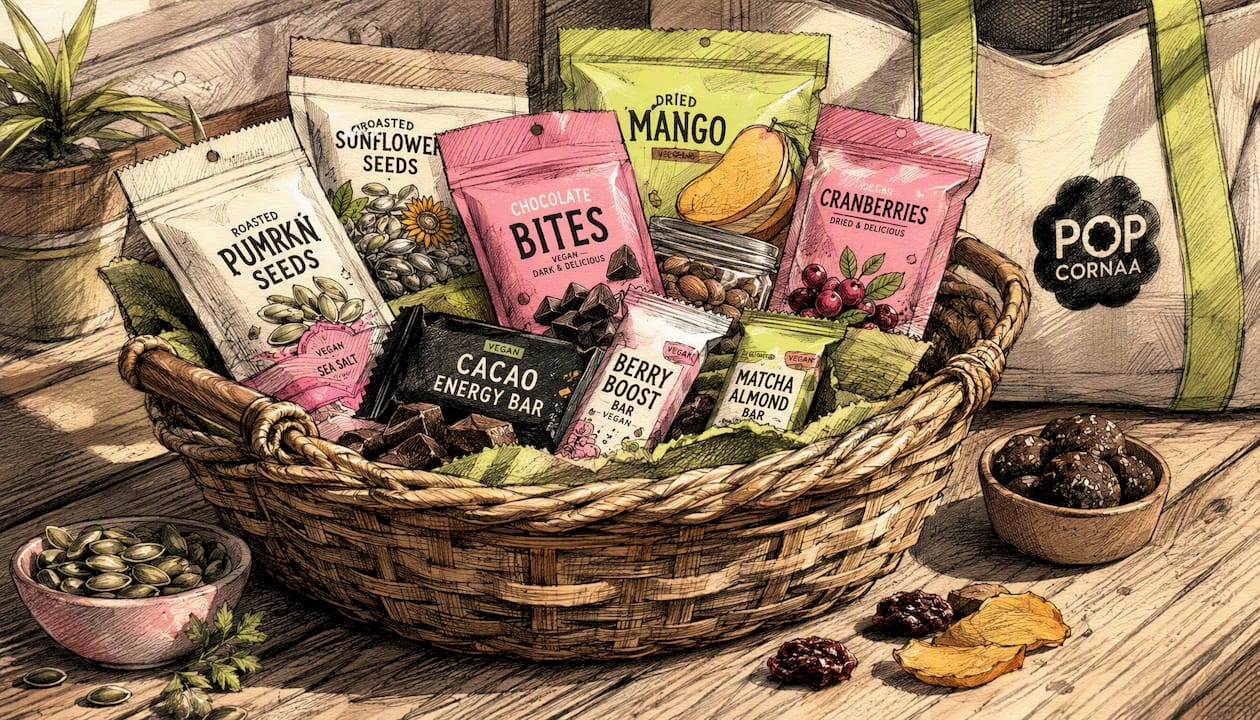
A practical starter list covers eight core categories. You don’t need to overhaul your whole shop at once. Pick two or three items from each category on your first trip, then build from there.
| Category | Starter examples | Where to find in UK stores |
|---|---|---|
| Crisps | Plain salted crisps, lightly salted rice cakes, sea-salt popcorn | Main snack aisle, own-brand section |
| Chocolate | Dark chocolate (70%+ cocoa, dairy-free), cocoa-dusted almonds | Confectionery aisle, free-from bay |
| Biscuits | Digestive biscuits (plain), oat biscuits, ginger nuts | Biscuit aisle (check each flavour) |
| Popcorn | Plain or lightly salted, sweet popcorn (check butter content) | Snack aisle, vegan bay |
| Nuts and seeds | Dry-roasted peanuts, mixed seeds, roasted chickpeas | Snack aisle, health food section |
| Dried fruit | Medjool dates, mango strips, raisins | Baking aisle, health food section |
| Bars | Date-and-nut bars, oat-based bars (check honey) | Health food section, checkout aisle |
| Fresh snacks | Carrot sticks, apple slices, hummus pots | Chilled aisle, prepared snacks section |
A few notes on seasonal and regional availability: Medjool dates appear in most major supermarkets year-round, but loose dried fruit from specialist sections can thin out in summer. Roasted chickpeas and edamame snacks are more reliably stocked in Tesco and Sainsbury’s larger formats than in smaller Express or Local stores. Waitrose tends to carry a broader own-brand free-from range, which is worth checking if you’re near one.
Which packaged snacks are ‘accidentally vegan’ in UK supermarkets?
Some of the most satisfying snacks on UK shelves were never designed with vegans in mind. They just happen to contain no animal products. Recipe variability between retailers and flavours is common, so check each flavour and pack individually, but these categories are reliable starting points.
- Plain salted crisps. Most own-brand plain crisps contain only potato, oil, and salt. Flavoured varieties are where dairy and milk powder creep in, so stick to unflavoured or check the label carefully.
- Digestive biscuits (plain). The standard plain digestive from most UK supermarkets contains no dairy. Chocolate-coated versions almost always do, so treat those as a separate check.
- Ginger nut biscuits. A classic accidentally-vegan biscuit. The spiced dough rarely needs milk or eggs, though recipes do vary between brands.
- Certain dark chocolates. Dark chocolate at 70% cocoa or above is often dairy-free, but always check the ingredient list. Some manufacturers add milk fat or use shared equipment.
- Boiled sweets and fruit pastilles. Many boiled sweets are vegan, but gelatine-based sweets (gummy bears, marshmallows) are not. Fruit pastilles from some brands contain gelatine; others don’t. Check every time.
- Dried fruit. Raisins, sultanas, dried mango, and apricots are almost always vegan. The exception is glazed or yoghurt-coated varieties.
- Popcorn (plain or lightly salted). Plain air-popped or lightly salted popcorn is typically vegan. Butter-flavoured, toffee, or cheese varieties need a label check.
- Pretzels (plain). Most plain pretzels are vegan. Flavoured or coated versions may contain dairy.
The important caveat: recipe reformulations happen frequently, and a product that was accidentally vegan last year may have gained a dairy derivative in its latest batch. Re-check labels regularly rather than assuming a product is safe because it was last time.
How do you read labels quickly in a UK supermarket?
The fastest route is a three-step check, and it takes under a minute once you know what to look for.
Step 1: Front of pack. Look for the Vegan Trademark sunflower logo or the words “suitable for vegans.” If either is present, you’re done. Be more cautious with “vegan friendly” or “plant-based,” as these terms are not consistently defined and carry no independent verification.
Step 2: Allergen emphasis. UK law requires that 14 major allergens, including milk and eggs, be emphasised on prepacked food labels, typically in bold. Scanning the bolded words in the ingredient list takes seconds and catches the most common animal derivatives. This doesn’t catch everything (carmine, for example, is not an allergen), but it eliminates most dairy and egg quickly.
Step 3: ‘May contain’ and facility notes. A vegan label and a free-from label communicate different things. GOV.UK guidance confirms that a product labelled vegan may still carry a ‘may contain’ allergen statement, because vegan status relates to ingredients, not to cross-contamination controls. If you have a dairy or egg allergy alongside your vegan preference, check the ‘may contain’ line separately.
On ambiguous terms: “dairy-free” and “lactose-free” do not automatically mean vegan. A product can be dairy-free but still contain eggs, honey, or gelatine. Veganuary’s label-reading guidance makes this distinction clearly, and it’s one that catches a lot of shoppers off guard.
Pro Tip: When contacting a manufacturer, ask specific questions rather than “is it vegan?” Try: “Does this product contain whey, casein, gelatine, shellac, beeswax, or carmine? Are any processing aids animal-derived?” You’ll get a far more useful answer.
Sneaky non-vegan ingredients and E-numbers to watch for
This is the watchlist that saves you from the most common surprises. Keep it on your phone for in-store checks.
- E-numbers to check: — E120 (carmine), E441 (gelatine), E542 (bone phosphate), E901 (beeswax), E904 (shellac), E920 (L-cysteine, often from feathers). Veganuary’s ingredient guidance covers these in detail.
Where can you buy vegan snacks in the UK?
The short answer: almost everywhere, but the right channel depends on what you’re after.
| Channel | Best for | Caveats |
|---|---|---|
| Tesco (main store) | Wide own-brand range, dedicated Plant Chef section | Smaller Express stores stock less |
| Sainsbury’s | Free-from bay, own-brand vegan labelling | Check flavour-by-flavour on crisps |
| Waitrose | Premium own-brand vegan range, broader free-from | Higher price point |
| Health food shops | Specialist brands, bulk nuts and seeds | Variable stock, regional |
| Online specialist retailers | Curated vegan ranges, subscription boxes, rare flavours | Delivery lead time |
| Direct from brand | Freshest stock, customisable boxes, gift options | Minimum order may apply |
Supermarkets have invested heavily in dedicated vegan or plant-based bays, and shopping these sections first reduces label-checking fatigue considerably. You’re more likely to find reliably labelled products there than in the general snack aisle, where accidentally-vegan items sit alongside non-vegan ones with no visual distinction.
For discovering new and innovative vegan flavours, online specialist retailers and direct-from-brand options are genuinely worth exploring. Supermarket shelves rotate stock seasonally, and limited-edition or small-batch flavours rarely make it to physical stores outside major cities. Subscription boxes and curated taster sets let you try a wider range without committing to a full-size bag of something you might not enjoy.
Regional note: London and other major cities tend to see new vegan snack lines earlier than rural areas. If you’re outside a city, online ordering is often the most practical route to the full range of what’s available.
Quick snack ideas, combos and packing tips
Good snacking is about balance, and a little planning goes a long way.
- Sweet and salty combo. Pair dark chocolate squares with lightly salted popcorn. The contrast is genuinely satisfying, and both items are easy to find in any UK supermarket.
- Protein and fibre pairing. Roasted chickpeas with a handful of dried mango. Chickpeas bring protein and crunch; mango adds natural sweetness and keeps energy levels steady.
- Dipping idea. Carrot sticks or cucumber slices with hummus. Most supermarket hummus is vegan, but check for dairy-based dips nearby that look similar.
- Kids’ lunchbox swap. Replace cheese crackers with plain rice cakes and a small pot of nut butter (check school allergy policies first). Add raisins or dried apricots for sweetness.
- On-the-go pack. A small zip-lock bag with mixed seeds, a date-and-nut bar, and a piece of dark chocolate. Fits in a pocket, needs no refrigeration, and keeps you going for hours.
- Party sharing platter. A mix of plain crisps, popcorn, olives, hummus, and crudités scales easily. Label each bowl clearly if guests have allergies, and keep the Vegan Trademark items together so guests can self-select.
- Quick snack assembly. Spread almond butter on a rice cake, top with banana slices and a pinch of cinnamon. Ready in two minutes, no cooking required.
How do you keep vegan snacking affordable in the UK?
Vegan snacking does not have to cost more than conventional snacking. The gap narrows considerably once you know where to look.
Own-brand swaps are the single biggest saving. Tesco, Sainsbury’s, and Waitrose all produce own-brand plain crisps, rice cakes, and dried fruit that are often accidentally vegan and significantly cheaper than branded equivalents. The ingredient lists are usually simpler, too.
Buying nuts, seeds, and dried fruit in bulk from the baking or health food aisle almost always beats the snack-aisle price per gram. A 500g bag of mixed seeds from the baking section typically costs less than two small snack-sized packets from the health food aisle.
Pro Tip: Check the unit price (price per 100g) on the shelf label rather than comparing pack prices. A larger bag that looks expensive is often cheaper per gram than the smaller “snack pack” version.
Frozen fruit is worth considering for smoothies and blended snacks. It’s cheaper than fresh, has a longer shelf life, and retains most of its nutritional value. For fresh snacks like carrot sticks and apple slices, buying whole vegetables and cutting them yourself costs a fraction of pre-prepared packs.
On sustainability: choosing snacks with minimal or recyclable packaging reduces waste and often signals a brand that takes ingredient sourcing seriously. Sustainable vegan snack brands in the UK increasingly use compostable or recycled materials, and buying in slightly larger quantities reduces packaging per serving. Reusable tins or containers for portioning bulk snacks at home are a small investment that pays off quickly.
When it is worth paying more: certified vegan products with ethical sourcing claims (fair-trade cocoa, Rainforest Alliance nuts) do carry a premium, but for staple items like plain popcorn or rice cakes, the own-brand version is usually just as good.
A quick verification checklist for buying vegan snacks
Use this before you put anything in your basket.
- Spot the Vegan Trademark. The sunflower logo from The Vegan Society is independent assurance. With over 70,000 products certified, you’ll find it on more items than you might expect.
- Scan the ingredient list for high-risk items. Gelatine, whey, casein, lactose, carmine (E120), shellac (E904), beeswax (E901), honey.
- Check the allergen emphasis. Bold or highlighted ingredients under UK law include milk and eggs. A quick scan of the bolded text catches most dairy derivatives in seconds.
- Review the ‘may contain’ statement. This matters most if you have an allergy alongside your vegan preference. A vegan claim does not guarantee allergen-free production.
- Contact the manufacturer for ambiguous ingredients. Ask specifically about glycerin, stearic acid, vitamin D3 source, and any processing aids. Precise questions get precise answers.
Pro Tip: When buying in bulk or stocking up on a favourite, check the pack date or product code against the brand’s website. Recipe reformulations are the main reason a previously safe product changes status, and brands sometimes post reformulation notices online before updating the physical label.
Which UK brands specialise in vegan snacks?
Several UK brands have built their entire range around vegan credentials, making them reliable choices without the label-checking effort.
Proper Snacks produces popcorn and crisps that are clearly labelled and widely stocked in UK supermarkets. Their popcorn range includes several Vegan Trademark certified flavours. Hippeas makes chickpea puffs that are certified vegan and available in Tesco, Sainsbury’s, and Waitrose. Nakd bars (made by Natural Balance Foods) are a staple in the health food section: whole-food date-and-nut bars with no added sugar, most of which are vegan and gluten-free.
For chocolate, Montezuma’s produces a range of dark chocolates that are vegan-certified and made in the UK. Doisy & Dam make vegan chocolate buttons and bars stocked in major supermarkets and health food shops. Both brands are worth bookmarking if you’re building a reliable go-to list.
Popcornaa sits in a different space: gourmet vegan popcorn with Asian-inspired and British flavours, sold direct online. If you want something beyond the standard supermarket shelf, their curated boxes are a practical way to try flavours you won’t find in a Tesco aisle.
For low-calorie options, brands like Eat Real (lentil and quinoa crisps) and Graze (portioned nut and seed mixes) offer clearly labelled vegan products with calorie information on the front of pack.
Key takeaways
The most reliable approach to vegan snack shopping in the UK is to lead with the Vegan Trademark, back it up with a short ingredient watchlist, and use supermarket vegan bays to reduce the effort of discovery.
| Point | Details |
|---|---|
| Vegan Trademark first | Over 70,000 products are certified; it is the fastest single front-of-pack check. |
| Allergen emphasis helps | UK law requires milk and eggs to be bolded on labels, making dairy checks quick. |
| Accidentally vegan staples | Plain crisps, digestive biscuits, dark chocolate, and dried fruit are reliable starting points. |
| Budget tip | Own-brand swaps and bulk buying from the baking aisle cut costs without losing variety. |
| Popcornaa for instant curation | Popcornaa’s curated vegan popcorn boxes remove label-reading effort and introduce new flavours. |
Why the certification-first approach actually works
There’s a tendency in vegan shopping guides to lead with the long ingredient watchlist, as if memorising forty E-numbers is the practical starting point. It isn’t. Most shoppers, myself included, don’t have the bandwidth to cross-reference a full watchlist while navigating a busy supermarket aisle on a Tuesday evening.
What stopped me in my tracks when I first started paying attention to this was how much simpler it became once I reversed the order. Start with certification. The Vegan Trademark exists precisely so you don’t have to parse every label from scratch. Use the allergen emphasis as your second filter, because UK law has already done part of the work for you. Only then, for the genuinely ambiguous items, reach for the watchlist.
The checklist approach in this guide isn’t just about efficiency. It’s about reducing the decision fatigue that makes people give up and grab whatever’s easiest. When you have a clear, short sequence to follow, the whole shop feels less like a research project and more like, well, shopping. That shift matters, especially if you’re new to this or buying for a family with mixed dietary needs.
Popcornaa: gourmet vegan popcorn and curated snack boxes, delivered to your door
If label-reading in the snack aisle feels like more effort than it should be, Popcornaa offers a genuinely simpler alternative. Every product in their range is vegan, so there’s no watchlist required, no allergen emphasis to decode, and no risk of accidentally picking up a reformulated flavour.
[ ](https://www.popcornaa.com › pages › asian-fusion-taster-box)
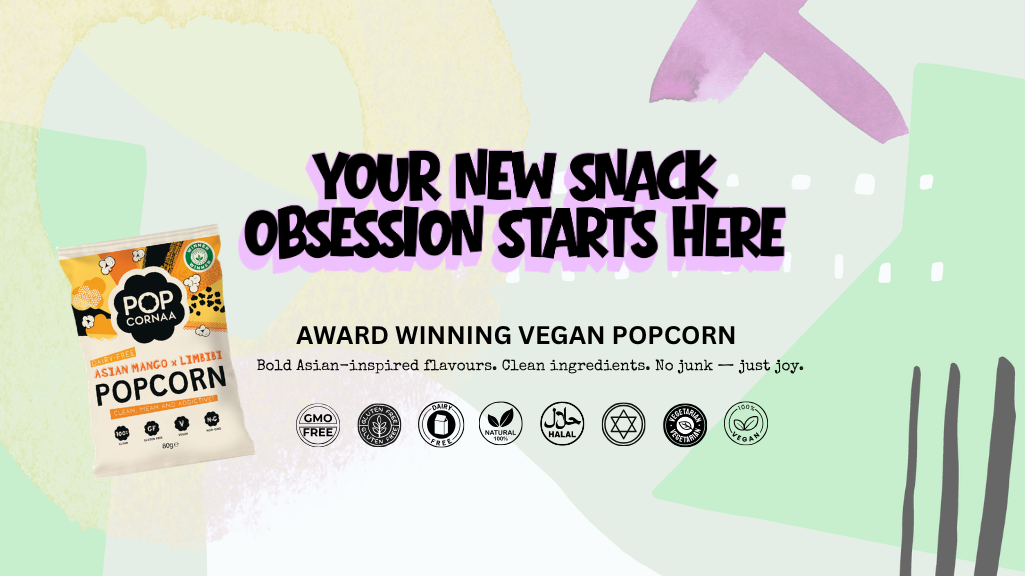
Popcornaa specialises in gourmet vegan popcorn with Asian-inspired and British flavour profiles, sold in curated boxes that work equally well as a personal treat, a gift, or a party sharing spread. Their Asian Fusion Taster Box is a five-bag selection that lets you try the range without committing to a full-size order. It’s a practical first step for anyone who wants reliably vegan snacks with flavours that go well beyond the standard supermarket shelf. UK delivery is available, and the boxes can be customised, making them a straightforward option for gifting or group snacking.
Useful sources and links
| Source | What it offers |
|---|---|
| The Vegan Society — Vegan Trademark | Certification database and information on the Vegan Trademark programme |
| Veganuary — accidentally vegan products UK | Practical list of commonly accidentally-vegan UK products and ingredient guidance |
| Veganuary — vegan label reading guide | Step-by-step guide to reading UK food labels for vegan status |
| GOV.UK — food allergen labelling technical guidance | Official UK guidance on the 14 allergens and labelling requirements |
| GOV.UK — understanding food labelling | Plain-language explanation of UK food label rules, including vegan claims |
FAQ
What are some good vegan snacks to buy in the UK?
Plain salted crisps, dark chocolate (70%+ cocoa), digestive biscuits, dried fruit, roasted chickpeas, and date-and-nut bars are reliable starting points available in most UK supermarkets. Look for the Vegan Trademark to confirm status without reading the full ingredient list.
What vegan snacks are available at UK supermarkets?
Tesco, Sainsbury’s, and Waitrose all stock dedicated vegan or plant-based sections with clearly labelled crisps, popcorn, bars, and confectionery. Own-brand ranges from each retailer include several accidentally-vegan staples at lower price points.
What should I include on a vegan shopping list?
Cover the core categories: crisps, popcorn, dark chocolate, plain biscuits, nuts and seeds, dried fruit, oat-based bars, and fresh snacks like hummus and crudités. Eight to twelve items across these categories gives you a solid, varied starter set.
Which snacks are surprisingly vegan?
Plain digestive biscuits, ginger nut biscuits, many boiled sweets, plain pretzels, and lightly salted popcorn are often accidentally vegan. Recipes vary between brands and flavours, so check the label each time rather than assuming a whole product range is safe.