

Vegan snacks vs traditional snacks: what's the difference?
TL;DR:
- Vegan snacks are made entirely from plant-based ingredients and generally have higher fiber and lower saturated fat than traditional snacks. The health benefits depend on ingredient quality and processing level, not just the vegan label; heavily processed options can be less healthy. Ethical and environmental factors are driving more consumers to choose plant-based snacks, often at comparable prices to conventional options.
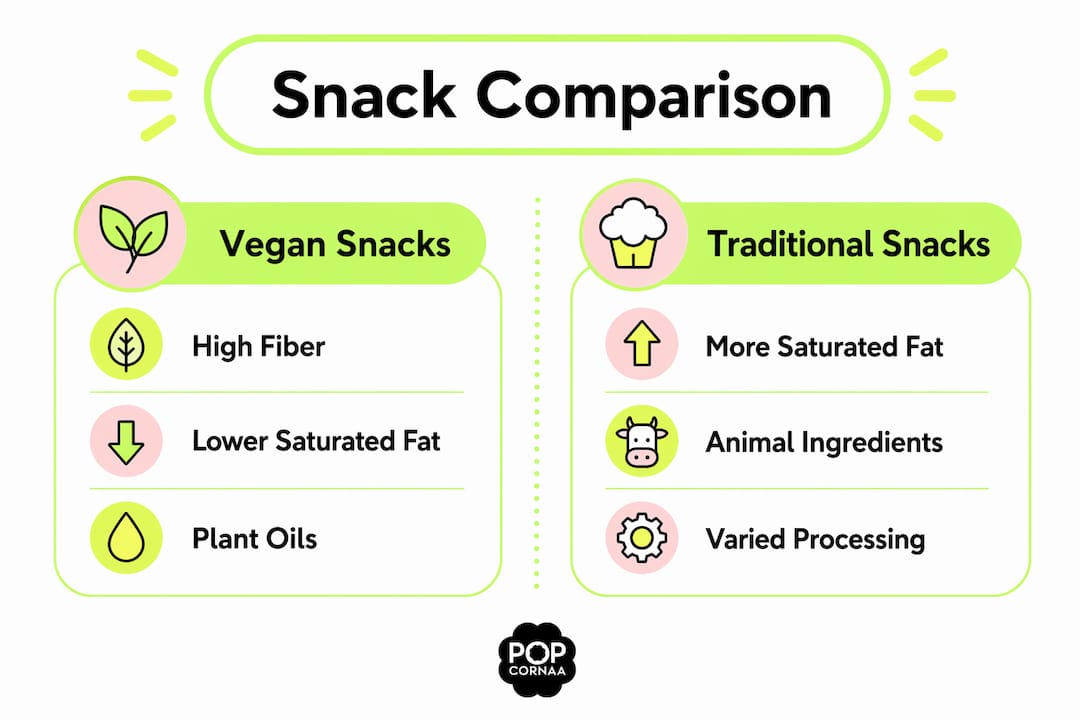
Vegan snacks are defined as products made entirely from plant-based ingredients, with no animal-derived components whatsoever. Traditional snacks, by contrast, frequently include dairy, meat, eggs, or animal-derived fats, and tend to undergo heavier processing. The gap between these two categories matters more than most people realise. Whether you are motivated by health, animal welfare, or the planet’s future, understanding the real differences between vegan snacks vs traditional snacks helps you make choices you can feel good about. Popcornaa exists in this space, crafting gourmet plant-based snacks that prove vegan eating does not mean sacrificing flavour.
What nutritional differences exist between vegan snacks and traditional snacks?
Nutrition is where the comparison gets genuinely interesting. Health experts recommend that a quality snack delivers at least 5g of protein and 3g of fibre per serving, with fewer than 5g of added sugar. That benchmark applies equally to plant-based and conventional options, and it is a useful filter when you are standing in a supermarket aisle feeling unsure.
Plant-based snacks built on beans, peas, nuts, seeds, and grains typically deliver higher fibre and lower saturated fat than their animal-protein counterparts. The trade-off is protein completeness. A single plant source rarely provides all nine essential amino acids in the right ratios, whereas animal proteins naturally do. That said, diverse plant ingredients combined well can match animal protein quality, which is why a snack mixing chickpeas, pumpkin seeds, and quinoa outperforms a single-ingredient plant crisp.
Fat quality is another meaningful difference. Vegan snacks commonly use olive or sunflower oils, which carry lower saturated fat levels than the fats often found in traditional crisps, cheese puffs, or meat-based snacks. Lower saturated fat intake is linked to better cardiovascular health over time. That is not a small detail.
The processing question cuts across both categories. An NIH trial found that ultra-processed diets increase daily calorie intake by approximately 508 calories, causing an average weight gain of 0.9 kg over just two weeks. This happened even when calorie and macronutrient content appeared matched on paper. The implication is clear: the form of food matters as much as its nutritional label.
Typical nutritional comparison
| Nutrient | Vegan snack (typical) | Traditional snack (typical) |
|---|---|---|
| Fibre per serving | Higher (3–6g) | Often lower (0–2g) |
| Saturated fat | Generally lower | Often higher |
| Protein completeness | Variable | Usually complete |
| Added sugar | Varies widely | Varies widely |
| Artificial additives | Fewer in whole-food versions | More common |
- Aim for snacks with at least 3g of fibre to support gut health and satiety.
- Check that protein comes from a named whole-food source, not an isolate.
- Treat added sugar above 5g per serving as a warning sign, regardless of the vegan label.
Pro Tip: Flip the packet and read the ingredient list before the nutrition panel. If the list is longer than ten items and contains words you would not find in a home kitchen, put it back.
How do ingredient lists and processing levels differ?
The vegan label does not guarantee health. A vegan biscuit loaded with refined sugar, palm oil, and flavour enhancers is nutritionally closer to a conventional biscuit than to a handful of mixed nuts. Metabolic health links more closely to ingredient recognisability than to the nutrition facts panel alone. A long, complex ingredient list signals heavy processing, and heavy processing strips out the fibre and phytonutrients your body actually needs.
Ultraprocessing removes natural phytonutrients, fibre, and micronutrients that support metabolic health. Snacks with ingredients you could not find in a home kitchen carry real metabolic risks, regardless of whether they are labelled vegan or traditional. Whole-food vegan snacks, by contrast, tend to preserve these compounds. A roasted chickpea crisp with sea salt, olive oil, and chickpeas listed as the first ingredient is a fundamentally different product from a puffed corn snack with fifteen additives.
Vegan protein bars with cleaner ingredient lists using whole-food proteins and naturally occurring fibre outperform many conventional bars on metabolic measures. The key word is “cleaner.” Whole-food ingredients like nuts, seeds, oats, and legumes preserve the fibre and micronutrients that processing destroys. Understanding organic food additives helps you spot which additions are benign and which ones signal a heavily engineered product.
Here is what to look for on any snack label, vegan or traditional:
- Short ingredient list. Five to eight ingredients is a good target.
- Named whole foods first. Oats, almonds, chickpeas, and sunflower seeds should appear before any oil or sweetener.
- No isolates as the primary protein source. Pea protein isolate is not the same as whole peas.
- Minimal sweeteners. Date paste or a small amount of maple syrup is preferable to glucose-fructose syrup.
- Recognisable oils. Olive oil and sunflower oil beat partially hydrogenated vegetable fat every time.
Pro Tip: When comparing two snacks, count the ingredients you could buy in a supermarket as whole foods. The snack with the higher count is almost always the better choice.
What are the ethical and environmental considerations?
Choosing between plant-based and conventional snacks is rarely a purely nutritional decision. For a growing number of people in the UK, ethics and environmental impact sit at the centre of the choice. UK shoppers are increasingly shifting towards whole-food, smarter vegan snacks as a lifestyle statement, seeking simpler ingredients and better nutritional profiles alongside a reduced environmental footprint.
Animal agriculture contributes significantly to greenhouse gas emissions, water consumption, and land use. Every traditional snack containing dairy, meat, or eggs carries that footprint embedded in its supply chain. Vegan snacks, by removing animal ingredients entirely, sidestep the most resource-intensive parts of food production. That does not make every vegan snack environmentally perfect. Palm oil, long-distance ingredient sourcing, and excessive packaging all add environmental costs. But the baseline footprint of a plant-based snack is generally lower.
Animal welfare is the other ethical pillar. Many people who choose sustainable vegan snack brands do so because they object to the conditions of industrial animal farming, not because they have read a nutrition study. That is a completely valid reason, and it is worth naming it plainly. Ethical motivation and health motivation often reinforce each other, which is why the shift to plant-based snacking in the UK reads as a sustained lifestyle movement rather than a passing trend.
The practical upside for consumers is that vegan snack pricing now frequently matches traditional snacks due to increasing supermarket availability and the growth of own-brand plant-based lines. The cost barrier that once made vegan snacking feel exclusive has largely disappeared. You can now make an ethical choice without paying a premium for it.
How can you choose the healthiest and most satisfying snacks?
Choosing well is a skill, and it gets easier with practice. The goal is to find snacks that satisfy hunger, taste genuinely good, and do not leave you reaching for something else twenty minutes later. These five steps work for both vegan and traditional options, though whole-food plant-based snacks tend to score well across all of them.
-
Check the protein and fibre first. A snack with at least 5g of protein and 3g of fibre will keep you fuller for longer. This is the single most reliable predictor of satiety.
-
Read the ingredient list, not just the front of the packet. Front-of-pack claims like “natural” or “plant-based” mean very little without a clean ingredient list to back them up.
-
Watch portion size and calorie density. Nuts and seeds are nutritionally excellent but calorie-dense. A 30g portion of mixed nuts is a snack. A 100g portion is a meal.
-
Prioritise variety. Rotating between different snack types, roasted chickpeas one day, popcorn the next, mixed seeds after that, gives your gut microbiome a broader range of plant fibres to work with.
-
Choose snacks you actually enjoy. Sustainable snacking habits depend on taste. A snack you find dull will not replace the crisps in your cupboard. Popcornaa’s gourmet plant-based snack range proves that whole-food vegan snacking can be genuinely exciting, with Asian-inspired and British flavour profiles that make the healthy choice the enjoyable one.
For practical inspiration, a creative plant-based snack guide can help you move beyond the obvious options and find combinations that work for your lifestyle.
Key takeaways
Whole-food vegan snacks consistently outperform heavily processed traditional snacks on fibre, saturated fat, and metabolic health, but the vegan label alone is not a reliable health signal.
| Point | Details |
|---|---|
| Nutritional benchmark | Aim for snacks with at least 5g protein, 3g fibre, and under 5g added sugar per serving. |
| Processing matters most | A long, unrecognisable ingredient list signals metabolic risk, regardless of the vegan or traditional label. |
| Fat quality differs | Vegan snacks typically use lower-saturated-fat oils, which supports better cardiovascular health over time. |
| Ethics and environment | Plant-based snacks carry a lower environmental footprint and remove animal welfare concerns from the supply chain. |
| Price parity achieved | Vegan snack pricing now frequently matches traditional options, making ethical choices accessible to most budgets. |
Why I stopped treating the vegan label as a shortcut
Honestly, it took me longer than I would like to admit to stop assuming that “vegan” automatically meant “better.” I used to pick up a vegan chocolate bar in a health food shop and feel quietly virtuous, without once flipping it over to read the ingredient list. When I finally did, I found refined sugar, palm oil, and a list of additives that would not look out of place on a conventional confectionery wrapper.
What shifted my thinking was paying attention to how I felt after eating different snacks. Whole-food plant-based options, roasted chickpeas, popcorn made with real ingredients, seed mixes, left me satisfied and energised. Heavily processed vegan snacks left me wanting more within the hour. That pattern is not coincidental. It reflects exactly what the research on ultra-processed foods shows about calorie intake and metabolic response.
I have also come to appreciate that the ethical motivation behind vegan snacking is worth taking seriously on its own terms. You do not need a nutritional justification to object to industrial animal farming. But the fact that whole-food plant-based snacking tends to be better for your body as well as the planet makes the choice feel genuinely coherent rather than a compromise.
My honest advice: ignore the front of the packet entirely. Read the ingredient list. If you recognise everything on it and the list is short, you are probably holding something worth eating. The benefits of vegan snacking are real, but they belong to the whole-food versions, not the processed ones wearing a plant-based badge.
— Emily
Popcornaa’s Asian Fusion Taster Box: vegan snacking made easy
If you want to experience what genuinely good plant-based snacking feels like, the Newbie Asian Fusion Taster Box from Popcornaa is a strong starting point. It brings together five bags of gourmet vegan popcorn, each inspired by bold Asian and British flavour profiles, made with real ingredients and without the long additive lists that undermine so many snack products.
[ ](https://www.popcornaa.com › pages › asian-fusion-taster-box)
Popcornaa crafts each flavour to satisfy genuine cravings, so you are not settling for something worthy but dull. The taster box is ideal if you are curious about plant-based snacking but want to try before committing to a larger selection. You can also explore the full vegan popcorn selection to find the flavours that suit you best. Good snacking should feel like a treat, not a trade-off.
FAQ
Are vegan snacks always healthier than traditional snacks?
No. The vegan label does not guarantee health. A vegan snack made with refined sugar, palm oil, and additives can be as nutritionally poor as any conventional processed snack. Ingredient quality and processing level determine healthfulness.
What makes a snack genuinely nutritious, vegan or not?
Health experts define an optimal snack as one providing at least 5g of protein and 3g of fibre per serving, with fewer than 5g of added sugar. A short, recognisable ingredient list is the clearest sign of minimal processing.
Do plant-based snacks cost more than traditional ones?
Vegan snack pricing now frequently matches traditional snacks, thanks to wider supermarket availability and the growth of own-brand plant-based ranges. The price premium that once existed has largely closed.
How do I know if a vegan snack is heavily processed?
Count the ingredients and check whether you could find them in a home kitchen. If the list exceeds ten items and includes isolates, sweeteners, or chemical-sounding additives, the snack is likely ultra-processed regardless of its vegan status.
Why are UK shoppers choosing vegan snacks more often?
UK shoppers are shifting towards whole-food vegan snacks as a lifestyle choice, driven by demand for simpler ingredients, better nutrition, and lower environmental impact. This reflects a sustained movement rather than a short-term dietary trend.