

Go dairy free: the health and practical reasons that matter
If you’re wondering whether to go dairy free, the honest answer is: it depends why you’re asking. If dairy leaves you doubled over with bloating and wind, cutting it out usually brings relief within days. If you’ve been diagnosed with a milk allergy, avoidance isn’t optional, it’s essential. And if your motivation is skin, digestion, or ethics, the evidence is real but more modest than the headlines suggest.
The most common reasons people go dairy free include:
- Lactose intolerance — digestive symptoms like bloating, cramping and diarrhoea after eating dairy
- Cow’s milk protein allergy — an immune reaction requiring strict avoidance
- Skin and digestive concerns — less consistent evidence, but widely reported
- Ethical or environmental motives — a lifestyle choice rather than a medical one
This piece walks through the testing process, what actually happens once you stop, the nutrients worth watching, and the practical swaps that make a dairy-free lifestyle sustainable rather than stressful.
Key Takeaways
Going dairy free works best when it is tested deliberately, backed by fortified nutrient replacements, and guided by a GP or dietitian for long-term or child-specific decisions.
| Point | Details |
|---|---|
| Test before assuming | Use a food and symptom diary and a 2 to 4 week elimination trial rather than guessing. |
| Know your condition | Lactose intolerance usually allows some tolerance; cow’s milk allergy requires strict, supervised avoidance. |
| Replace nutrients deliberately | Prioritise fortified plant milks, lactose-free dairy, tofu, canned fish and leafy greens for calcium, iodine and B12. |
| Reintroduce gradually | After symptom improvement, add small amounts back slowly to find your personal tolerance threshold. |
Why go dairy free: the evidence-based reasons
The NHS identifies lactose intolerance as the leading clinical reason people cut dairy. Symptoms including tummy pain, bloating, wind and diarrhoea typically appear within a few hours of eating dairy, and severity tracks with how much lactose you’ve consumed. For many people, removing dairy isn’t a lifestyle experiment. It’s the fastest route to feeling normal again after meals.
Lactose intolerance and cow’s milk protein allergy get lumped together constantly, but they’re entirely different mechanisms. Intolerance is digestive: your body lacks enough lactase enzyme to break down milk sugar, so it ferments in the colon and causes discomfort. Allergy is immune: your body treats milk protein as a threat and can react with hives, swelling or, in severe cases, anaphylaxis. One is uncomfortable. The other can be dangerous, which is why allergy demands strict avoidance rather than the tolerance testing suitable for intolerance.
Beyond diagnosed conditions, people report a mixed bag of other benefits:
- Improved digestion — commonly reported, though evidence quality varies between individuals
- Clearer skin — anecdotally linked to dairy reduction, though a systematic review of dairy and health outcomes suggests the connection is inconsistent across studies
- Lower saturated fat intake — a more measurable outcome, since dairy is a major dietary source
None of this means dairy is universally bad. It means the reasons for cutting it are genuinely different from person to person, and worth being honest about before you start.
What happens to your body when you quit dairy
Most people notice digestive changes within days. If lactose intolerance is behind your symptoms, bloating and discomfort typically ease within 48 hours of full removal, though some people take longer depending on how much lactase activity they still have. The British Dietetic Association and hospital dietetics teams generally recommend a trial period of a few weeks before drawing conclusions, since a few good days early on can be misleading.

Reassuringly, lactose intolerance doesn’t cause lasting damage to your gut. It’s uncomfortable, not destructive, which means there’s little risk in testing it properly rather than guessing forever.
Pro Tip: Once symptoms have settled for two to four weeks, reintroduce dairy in small, deliberate amounts, a splash of milk in tea, a small piece of cheese, rather than a full glass of milk. This helps you find your personal tolerance threshold instead of assuming total avoidance is the only option.
A few caveats worth knowing:
- Secondary lactose intolerance (following illness or gut inflammation) can take longer to resolve than the primary kind
- Suspected milk allergy is a different situation entirely and needs clinician supervision, not DIY reintroduction
Nutrients to watch for, and what replaces them
Dairy is a concentrated source of several nutrients, and the NHS is clear that anyone considering long-term removal should speak to a GP or registered dietitian first, particularly children, pregnant women, and breastfeeding parents. For practical food-based guidance on maintaining bone health without dairy, consult this foods for bone density: targets and serving guide. The nutrients that matter most are calcium, iodine, vitamin B12, vitamin D and protein.
| Nutrient | Dairy source | Non-dairy alternative |
|---|---|---|
| Calcium | Milk, cheese, yoghurt | Fortified plant milks (Alpro, Oatly, Provamel), tofu, canned fish with bones, leafy greens |
| Iodine | Cow’s milk | Fish, eggs, seaweed (check plant milk labels, not all are fortified) |
| Vitamin B12 | Milk, cheese | Fortified plant milks, nutritional yeast, fortified cereals |
| Vitamin D | Fortified milk | Fortified plant milks, sunlight, supplements where advised |
| Protein | Milk, cheese, yoghurt | Tofu, legumes, fortified soya products |
Mayo Clinic’s guidance on non-dairy calcium highlights canned fish with bones, tofu and leafy greens as reliable food-based options alongside fortified drinks. For families with young children, lactose-free options like Lactofree or Lactaid can bridge the gap without a full dietary overhaul, while infants with a diagnosed milk allergy may need a hypoallergenic formula prescribed by a paediatrician.
A quick safety note: not every plant milk is fortified to the same level. Some own-brand or barista-style versions skip added calcium and iodine entirely, so check the nutrition panel rather than assuming.
- Speak to a GP or dietitian before removing dairy long term, especially for children or during pregnancy
- Combine two or three fortified sources rather than relying on one
- Recheck labels periodically as brands reformulate
How to test whether dairy is really the problem
Self-diagnosis is tempting, but the NHS advises against eliminating foods without some structure, since guessing wrong can mean cutting a nutrient-dense food for nothing. A clinically sensible approach looks like this:
- Keep a food and symptom diary for one to two weeks before changing anything, noting what you eat and how you feel afterwards
- Remove dairy strictly for two to four weeks, following the Gloucestershire Hospitals trial guidance
- Track whether symptoms improve, worsen, or stay the same
- Reintroduce dairy gradually and in small amounts, watching for a return of symptoms
If you suspect allergy rather than intolerance, don’t self-test. A GP can arrange skin prick tests, blood tests, or a supervised food challenge, and this distinction matters because allergic reactions can escalate unpredictably.
A food-and-symptom diary is the single most reliable tool for separating true dairy reactions from other causes. Without it, people often blame dairy for symptoms that actually come from something else entirely.
Self-diagnosis has limits. A registered dietitian can help you interpret an ambiguous diary and avoid cutting foods unnecessarily.
Shopping, labels and cooking without dairy
A sustainable dairy-free lifestyle comes down to a handful of habits rather than constant vigilance. Build a shopping list around fortified plant milks, lactose-free dairy such as Lactofree or Lactaid, fortified dairy-free yoghurts, calcium-rich canned fish, tofu and leafy greens, and fortified breakfast cereals.
Labels hide dairy more often than people expect. Watch for casein, whey, lactose, milk solids, and milk powder on ingredient lists, even on products that look plant-based at first glance, as the Gloucestershire Hospitals leaflet points out.
In the kitchen, oat or soya cream works well in most sauces and soups, and cheese substitutes such as Sheese or Vegusto can fill the gap in sandwiches or on top of pasta, though texture and melt behaviour differ from dairy cheese. Eating out just needs a bit of forward planning: check menus online beforehand, and don’t be shy about asking kitchen staff which dishes are made without butter or cream.
Pro Tip: Supermarket own-brand fortified plant milks are usually £0.30 to £0.50 cheaper per litre than branded versions and often carry the same calcium and B12 fortification, so check the own-label shelf before assuming premium brands are the only fortified option.
Dairy-free snacking, done properly
Good snacking doesn’t need dairy to feel satisfying. A few reliable combinations:
- Fortified plant-based yoghurt with berries and a scattering of seeds
- Nut butter on wholegrain crackers
- Tinned sardines on toast for a calcium and omega-3 hit
- Vegan cheese options like Sheese or Vegusto with oatcakes
- Flavoured popcorn, naturally dairy-free when made properly, as a savoury alternative to crisps
At Popcornaa, our gourmet popcorn is built without dairy from the start, using Asian-inspired and British flavours rather than butter-based coatings. It’s the kind of snack you can hand to a dairy-free household without checking three labels first. For more ideas along these lines, our piece on dairy-free snacking basics covers ingredient choices in more depth.
Pro Tip: Pair a handful of fortified plant yoghurt with a tablespoon of sesame or chia seeds. Together they contribute a meaningful portion of your daily calcium without a drop of dairy.
The hidden dairy hiding in everyday processed food
Dairy shows up in places that have nothing to do with milk or cheese. Bread, crisps, stock cubes, gravy granules, some crisps flavourings, processed meats, and even certain wines and beers can contain dairy-derived ingredients used for texture, browning or clarification.
Casein, a milk protein, turns up in some “non-dairy” coffee creamers and processed meat products as a binding agent, which catches out plenty of people who assume “non-dairy” means dairy-free by default. Whey powder appears in protein bars, baked goods, and even some crisps as a flavour enhancer or texturiser. Lactose, milk sugar rather than protein, is used as a bulking agent in medications, sliced meats, and instant soups.
Restaurant sauces are a particular blind spot. Butter or cream often thickens gravies, risottos and pan sauces without appearing on a printed menu description, which is why asking kitchen staff directly matters more than reading the menu alone.
Baked goods deserve extra scrutiny too. Many biscuits, cakes and pastries list milk powder or butter even in products that look plain, and “may contain milk” warnings on packaging reflect manufacturing cross-contact rather than a deliberate ingredient, but they still matter for anyone with a diagnosed allergy rather than a mild intolerance.
The pattern worth remembering: dairy is used as a functional ingredient, not just a flavour, so it appears in food categories that have nothing to do with milk on the surface. Checking the full ingredients list, not just the front-of-pack description, catches most of these.
Reading labels for dairy-derived ingredients
Ingredient labels list components in descending order by weight, so spotting dairy early in the list signals a bigger contribution to the product than one buried near the end. The words to scan for include milk, milk solids, milk powder, casein, caseinates, whey, whey protein, lactose, lactoglobulin, and lactalbumin. Some of these sound unfamiliar precisely because manufacturers use technical names rather than the word “milk” itself.
“Non-dairy” and “dairy-free” aren’t always regulated the same way across every product category, so a “non-dairy” label doesn’t guarantee zero dairy protein, particularly with coffee creamers and whipped toppings that can still contain sodium caseinate. If you have a diagnosed allergy rather than an intolerance, “may contain milk” warnings need to be taken seriously even when milk isn’t a deliberate ingredient, since trace cross-contact can still trigger a reaction.
Vegan certification logos are a more reliable shortcut than reading every ingredient yourself, since vegan-certified products cannot legally contain milk derivatives at all. That said, vegan doesn’t automatically mean allergy-safe from a cross-contamination standpoint, so check separately for “may contain” statements if your reaction is immune rather than digestive.
A practical habit: photograph the ingredients list of products you rely on regularly, so you can compare quickly if a brand reformulates. Manufacturers change recipes more often than people expect, and a product that was dairy-free last year isn’t guaranteed to stay that way.
Eating out and staying social without giving up dairy-free habits
Social eating is where most dairy-free diets get tested, and it’s also where people quietly give up. The fix isn’t avoiding restaurants. It’s a bit of preparation.
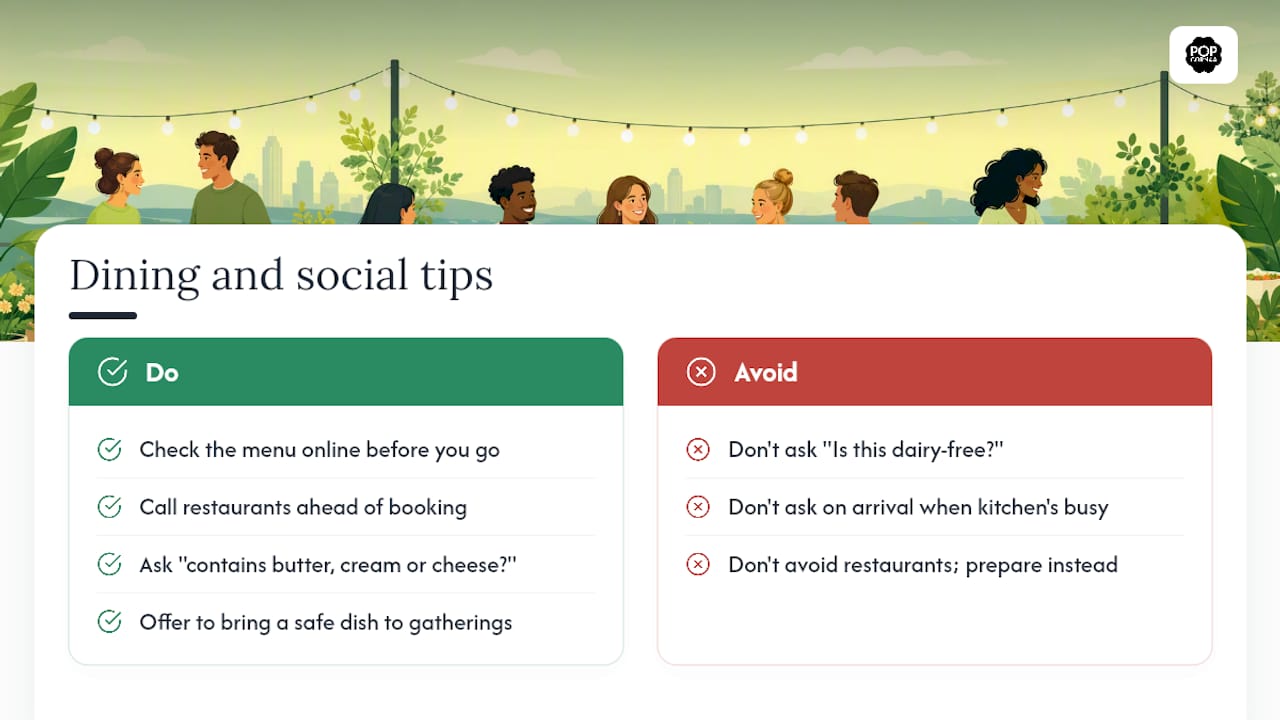
Checking a restaurant’s menu online before you arrive saves an awkward conversation at the table, and most chains now list allergen information on their websites. For independent restaurants without that detail, a quick phone call ahead of booking, rather than asking on arrival when the kitchen is already busy, tends to get a more thoughtful answer.
At the table, specific questions work better than vague ones. Asking “does this contain butter, cream or cheese” gets a clearer answer than asking “is this dairy-free”, which staff sometimes interpret loosely. Sauces, dressings and soups are the highest-risk items on any menu, since cream and butter are default thickeners in many cuisines.
Social gatherings and dinner parties carry a different kind of pressure, the social one rather than the practical one. Offering to bring a dish you know is safe takes the guesswork away from a host who may not know what “dairy-free” actually excludes. It also means you’re never relying entirely on someone else getting it right.
Travelling adds another layer, since dairy-free labelling conventions and common substitutes vary between countries. Learning a few key phrases in the local language, or carrying a translated allergy card, removes a lot of stress from ordering abroad.
None of this needs to feel like a burden. Most of it becomes automatic within a few weeks of practice, the same way any new habit does.
Reintroducing dairy safely after elimination
If your elimination trial was about intolerance rather than allergy, reintroduction is usually possible and often advisable, since permanent full avoidance isn’t always necessary once symptoms have settled. The standard approach is gradual: after two to four weeks of strict avoidance and clear symptom improvement, reintroduce small amounts of dairy one at a time rather than returning to your old diet all at once.
Start with something small, a splash of milk in tea or a teaspoon of yoghurt, and wait 48 hours before trying more. This gives your body time to show a reaction if one is coming, rather than muddying the results by eating multiple dairy products in the same day. If symptoms don’t return, gradually increase the quantity over the following weeks until you find your personal threshold, which for many people with lactose intolerance sits somewhere between “a splash in coffee” and “a full glass of milk”, not at zero.
Reintroduction after a confirmed cow’s milk allergy is an entirely different process and should only happen under clinical supervision, typically through a supervised food challenge arranged by an allergy specialist. Attempting this at home carries real risk, since allergic reactions can be unpredictable and, in some cases, severe.
Keep using your food and symptom diary through reintroduction. It’s the same tool that helped you identify the problem in the first place, and it’s just as useful for confirming where your tolerance line actually sits.
Why go dairy free is often the wrong first question
The conventional advice treats “should I go dairy free” as a yes or no decision, and that’s where most people get stuck. The more useful question is narrower: does dairy cause my specific symptoms, and if so, how much can I actually tolerate? Framing it that way turns an overwhelming lifestyle change into a manageable two-week experiment with a clear outcome.
What gets overlooked most often is how individual tolerance really is. Two people with the same intolerance diagnosis can have completely different thresholds, one manages a splash of milk in tea, another reacts to a teaspoon of yoghurt. Treating dairy-free as an all-or-nothing rule, rather than a personal dial to calibrate, is where a lot of unnecessary restriction and anxiety creeps in.
If there’s one priority worth acting on first, it’s the diary. Not the elimination, not the fortified milk shopping list, the diary. Everything downstream, your trial, your reintroduction, your conversation with a dietitian, works better with two weeks of honest data behind it.
This article is general information, not a substitute for advice from a qualified doctor. Consult a qualified healthcare professional about your own circumstances before acting on anything here.
Sources
- Lactose intolerance - NHS
- Cow’s milk allergy: management in practice - British Dietetic Association
- Eating lactose free - Gloucestershire Hospitals patient information
FAQ
Are there real benefits to going dairy-free?
Yes, particularly for people with lactose intolerance, where symptom relief from bloating, pain and diarrhoea is well documented. Benefits like clearer skin are reported more anecdotally and the evidence is less consistent.
Is it actually better to go dairy-free?
It depends on your reason. For diagnosed intolerance or allergy, yes, it’s usually necessary; for general health without symptoms, the NHS advises caution about removing a major nutrient source without a clear reason.
What happens to your body when you quit dairy?
Digestive symptoms linked to lactose intolerance typically improve within days to a couple of weeks, and there’s no evidence of lasting gut damage from the intolerance itself. Most clinicians recommend a two to four week trial before judging the results.
Can you survive without eating dairy?
Yes, provided you replace calcium, iodine, vitamin B12 and vitamin D through fortified plant milks, tofu, canned fish and leafy greens, ideally with guidance from a GP or dietitian for children or long-term diets.