

Why plant-based fats belong in your snacks
Plant-based fats are used in snacks primarily to replace higher-saturated animal fats, supply unsaturated fats linked to better blood-lipid profiles, and deliver the texture, mouthfeel, and shelf stability that make snacks genuinely enjoyable to eat. That is the short answer. The longer one involves chemistry, UK public-health guidance, and some honest caveats about what “plant-based” on a label actually guarantees.
Three reasons plant-based fats appear in snacks:
- Heart-health profile. Unsaturated plant fats, particularly polyunsaturated (PUFA) and monounsaturated (MUFA) types, are associated with lower LDL cholesterol and reduced cardiovascular risk when they replace saturated or trans fats.
- Sensory function. Fats carry flavour, create crispness, and give snacks their satisfying mouthfeel. Without them, most snacks would taste flat and feel dry.
- Labelling and market positioning. A plant-based fat source allows brands to carry vegan certification and appeal to the growing number of UK shoppers who actively read ingredient lists.
The evidence behind these claims comes from SACN, the NHS Eatwell Guide, Heart UK, and peer-reviewed reviews. Each is covered below.
Key takeaways
Plant-based fats improve snack nutrition when they are primarily unsaturated, but the “plant-based” label alone is not a guarantee of a heart-healthy product.
| Point | Details |
|---|---|
| Swap saturated for unsaturated | Choose snacks made with rapeseed, olive, or sunflower oil rather than coconut or palm oil. |
| Check per-100 g saturated fat | Under 5 g per 100 g is the green traffic-light threshold; above 10 g warrants caution. |
| Portion size matters | Even unsaturated fats supply around 9 kcal per gram; a 25–30 g handful of nuts is a realistic single portion. |
| “Vegan” does not mean heart-healthy | Ultra-processed plant-based snacks can be high in salt, sugar, or saturated tropical fats despite their label. |
| Popcornaa | Offers gourmet vegan popcorn with clearly listed plant-based fats and no dairy, making label-checking straightforward. |
Why are plant-based fats used in snacks?
To understand the answer properly, you need to know what the different fat types actually are, because “plant-based fat” covers a wide spectrum, from heart-friendly rapeseed oil to coconut oil, which behaves more like butter in your arteries.
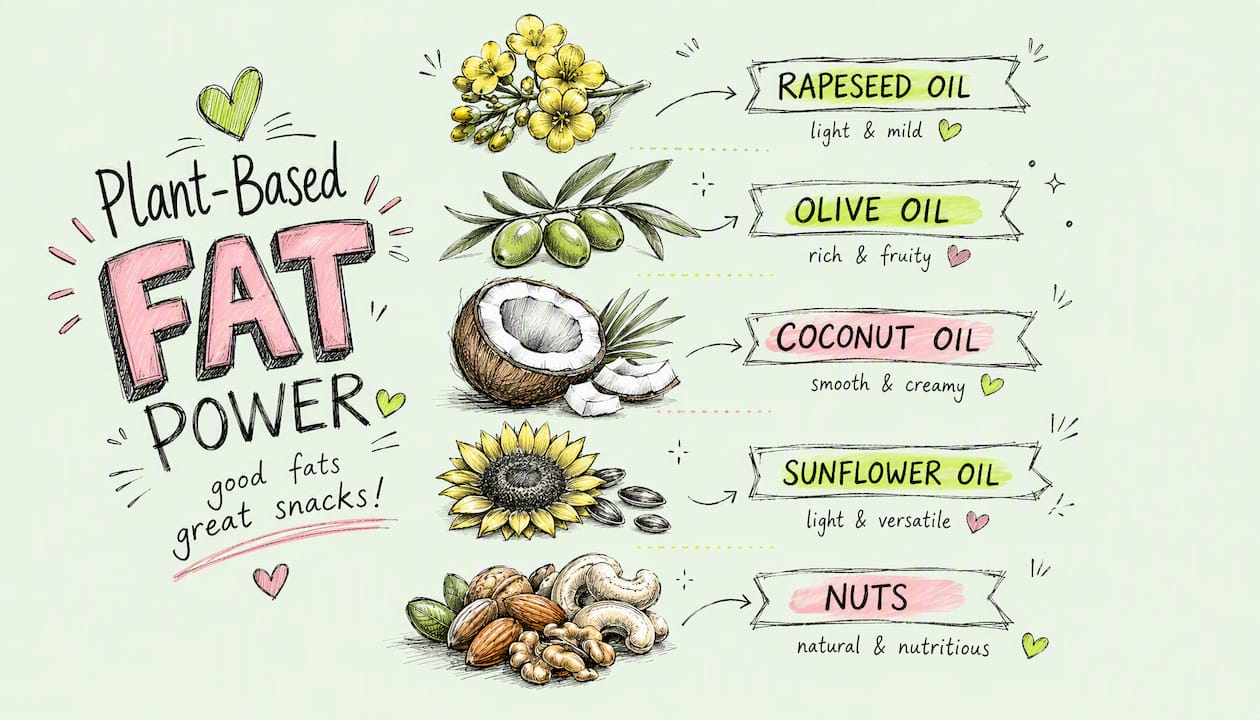
Saturated, unsaturated, and trans fats explained
Saturated fatty acids (SFA) have no double bonds in their carbon chain. They tend to be solid at room temperature, raise LDL cholesterol, and are found in animal products and tropical plant oils. Monounsaturated fatty acids (MUFA) have one double bond, remain liquid at room temperature, and are associated with neutral-to-positive effects on blood lipids. Polyunsaturated fatty acids (PUFA) have two or more double bonds, include omega-3 and omega-6 types, and show the strongest evidence for LDL reduction when they replace saturated fats. Trans fats arise when liquid oils are partially hydrogenated to extend shelf life; they raise LDL and lower HDL simultaneously, making them the most harmful fat type in processed foods.
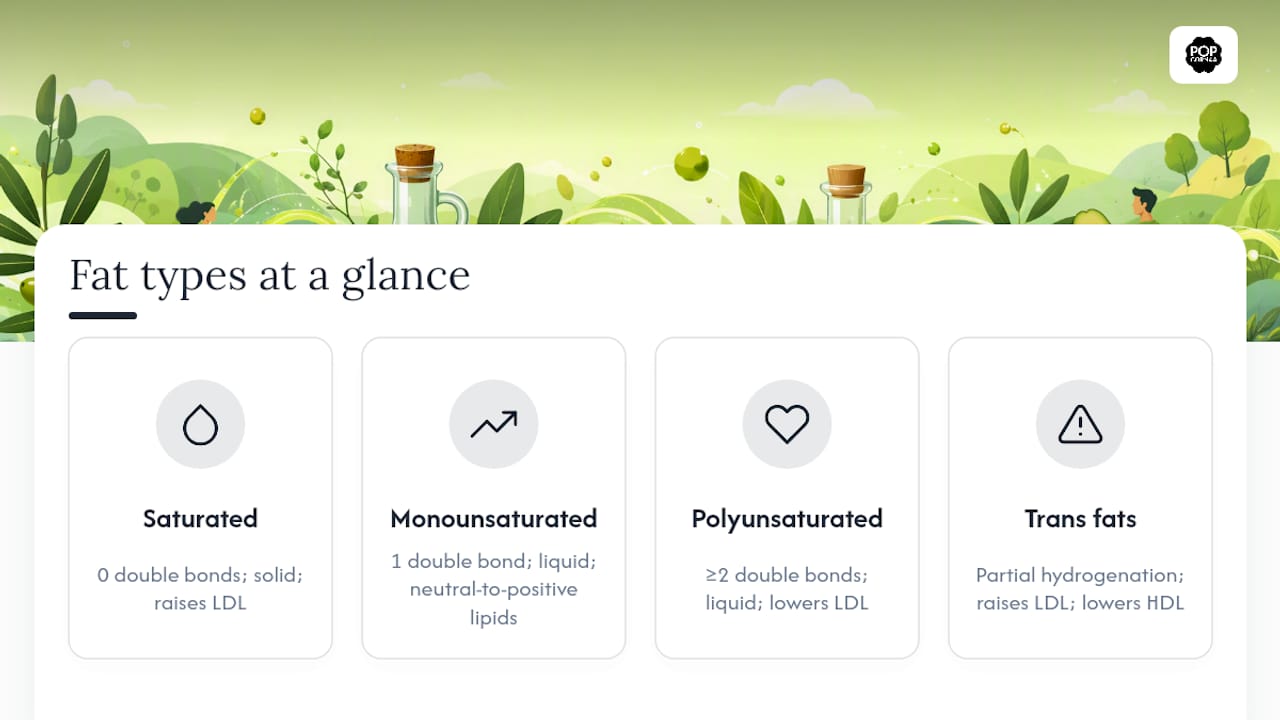
The double-bond count matters because it determines how a fat behaves both in your body and in a food product. More double bonds mean a lower melting point, a softer texture, and, critically, a more favourable cardiovascular profile.
Common plant-based fat sources in snacks
| Snack ingredient | Predominant fat type | Notes |
|---|---|---|
| Almonds, walnuts | MUFA and PUFA | Also supply fibre and protein; tree-nut allergen |
| Rapeseed oil | MUFA and PUFA | UK-grown; low in saturates; good all-round profile |
| Olive oil | MUFA | Rich in oleic acid; stable at moderate heat |
| Sunflower oil | PUFA (omega-6) | Widely used in UK snack manufacturing |
| Avocado | MUFA | High calorie density; rarely used as an oil in snacks |
| Coconut oil | SFA (high) | Plant-derived but raises LDL similarly to animal fats |
| Palm oil | SFA (moderate-high) | Cheap and stable; sustainability concerns |
| Seeds (flax, sesame, chia) | PUFA | Often added to bars and crackers for texture and nutrition |
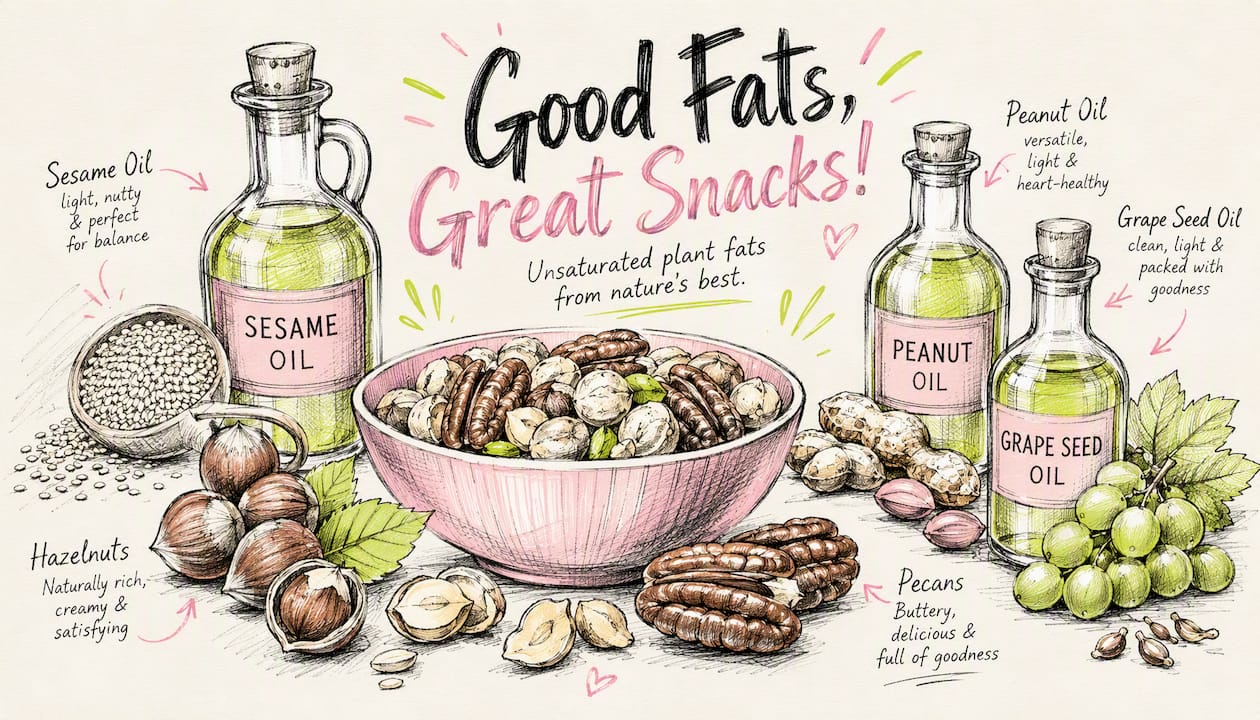
Coconut and palm oils deserve a specific mention. Both are plant-derived, yet both are high in saturated fat. Heart UK’s dietary fat guidance notes that large-scale reviews link higher PUFA intake from seed oils with lower cardiovascular risk when they replace saturated fat, and that seed oils such as rapeseed, sunflower, and flax are not the health threat some online commentary suggests. A snack made with coconut oil is not automatically a healthy choice simply because it carries a vegan label.
Allergen awareness matters here too. Nuts and seeds are among the 14 major allergens listed under UK food law, so any snack containing almonds, walnuts, or sesame must carry a clear declaration.
What does the evidence say about plant-based fats and heart health?
Substituting saturated or trans fats with unsaturated plant fats lowers LDL cholesterol and is associated with reduced cardiovascular risk. That finding runs consistently through UK public-health guidance and the peer-reviewed literature.
SACN’s report on saturated fat and health concluded that the UK population should reduce average saturated fat intake to no more than approximately 10% of dietary energy, and that substituting saturated fats with unsaturated fats brings measurable health benefits. The evidence for PUFA substitution is stronger, coming from randomised controlled trials as well as observational studies. MUFA substitution shows benefit too, though the RCT evidence base is smaller.
“Replacing small percentages of trans or saturated fats with unsaturated fats reduces coronary heart disease risk and improves blood-lipid markers.” NICE expert paper on saturated and unsaturated fats
Heart UK’s plant-based diet guidance reinforces this, noting that cardiovascular benefits from plant-based eating are driven by diet quality overall, specifically by replacing refined carbohydrates and high-saturated-fat foods with wholegrains, legumes, and unsaturated plant fats, rather than by the “plant-based” label alone.
UK NDNS data analysed in a Cambridge Public Health Nutrition study found that tree-nut snack consumers had lower BMI, lower blood pressure, and higher HDL cholesterol than non-consumers. Replacing refined-carbohydrate snacks with nuts may improve lipid profiles and support weight management without causing weight gain.
One important caveat: most large studies in this area are observational. People who eat more nuts and olive oil also tend to follow healthier diets overall, so isolating the fat type as the sole cause of better outcomes is difficult. Whole-diet quality matters more than any single nutrient swap.
Why do snack manufacturers choose plant-based fats?
The reasons are partly nutritional, partly technical, and partly commercial. Understanding them helps you read an ingredient list with more confidence.
Sensory reasons:
- Fats carry fat-soluble flavour compounds, which is why a popcorn coated in rapeseed oil tastes richer than one with no oil at all.
- The melting point of a fat determines mouthfeel. Cocoa butter melts at body temperature; coconut oil does too, which is why it gives chocolate-style coatings their snap and smooth finish.
- Crispness in baked or popped snacks depends on the fat’s ability to coat starch granules and inhibit moisture absorption.
Manufacturing and commercial reasons:
- Unsaturated oils such as sunflower and rapeseed are widely available in the UK, cost-effective at scale, and stable enough for most ambient snack formats.
- Plant-based fats allow brands to carry vegan certification, which opens access to a growing segment of UK shoppers. Industry reporting notes that UK consumers are increasingly label-savvy and that brands avoiding high-saturated fats and prioritising simple, fibre-rich ingredients are finding greater commercial success.
- Palm oil, despite its sustainability controversy, remains common in industrial baking because it is cheap, solid at room temperature, and extends shelf life without hydrogenation.
Pro Tip: When reading an ingredient list, the oils are listed in descending order by weight. If “palm oil” or “coconut oil” appears before “rapeseed oil” or “sunflower oil”, the product’s fat profile skews towards saturated. Flip the packet and check the per-100 g saturated fat figure to confirm.
For a deeper look at how fats carry flavour in snack formats, the PopCornaa guide to viral snack flavours covers how oil choice shapes the final taste experience.
How do you choose healthier plant-based snacks in the UK?
Prefer snacks where the fat comes primarily from unsaturated sources such as olive, rapeseed, or sunflower oil, and where saturated tropical fats are low or absent. That single rule eliminates most of the confusion.
Label checklist for UK shoppers:
- Saturated fat per 100 g: aim for under 5 g (traffic-light green) and be cautious above 10 g (red).
- Total fat per 100 g: context matters. Nuts are naturally high in total fat but predominantly unsaturated; a nut-based snack at 50 g fat per 100 g can still be a sound choice.
- Ingredient list order: look for rapeseed, olive, or sunflower oil near the top; treat palm or coconut oil near the top as a caution signal.
- Partially hydrogenated oils: if you see this phrase anywhere, put the product back. It signals industrially produced trans fats.
- Sugar and salt: many ultra-processed plant-based snacks compensate for reduced fat with added sugar or sodium. Check both.
- Portion size: the per-100 g figure is your comparison tool; the per-portion figure tells you what you actually consume.
Traffic-light labelling on UK packaging uses red, amber, and green for fat, saturated fat, sugar, and salt. Green on saturated fat is the signal to prioritise. Amber is acceptable in moderation. Red on saturated fat, combined with a large portion size, is where the health case weakens.
Pro Tip: Rather than overhauling your entire snack routine at once, swap one snack per day. Replace a packet of standard crisps with a 25–30 g portion of mixed nuts or a single-serve bag of popcorn made with rapeseed oil. Small, consistent swaps tend to stick far better than wholesale dietary changes.
For practical ideas on plant-based snack options that work in a UK context, PopCornaa’s 2026 guide covers a range of formats and flavour profiles.
What are the downsides of plant-based fats in snacks?
“Plant-based” does not mean low-calorie, low-saturated-fat, or minimally processed. These are the cautions worth keeping in mind:
- Calorie density. All fats supply roughly 9 kcal per gram, plant-derived or not. A 50 g bag of nut-based snacks can easily contain 300 kcal. Portion awareness matters.
- Coconut and palm oil. Both are plant-derived and both are high in saturated fat. Coconut oil is approximately 87% saturated fat, comparable to butter. A vegan label does not change that chemistry.
- Ultra-processed plant-based snacks. Comparative research published in Nature Food found that many plant-based alternatives are lower in saturated fat than their meat equivalents, but composition varies widely by product, and some are ultra-processed with elevated sugar or salt. Processing level is as important as fat type.
- Trans fats. Partially hydrogenated vegetable oils still appear in some imported or budget snack products. Always scan the ingredient list.
- Allergens. Nuts and seeds are common plant-based fat sources and major allergens. Cross-contamination warnings are legally required in the UK but still worth checking carefully.
A “vegan” or “plant-based” badge on a snack packet tells you about the sourcing of ingredients, not about their nutritional quality. For a clear-eyed comparison of vegan versus traditional snacks, the nutritional differences are more nuanced than the marketing often suggests.
Frequency and portion size remain the practical levers. Even a snack with an excellent fat profile becomes a problem when eaten in large quantities every day.
Practical snack swaps and portion examples
Replacing refined-carbohydrate snacks with plant-fat-rich alternatives is one of the most straightforward dietary improvements you can make. Here are swaps that work in practice:
- Replace standard salted crisps with air-popped popcorn made with rapeseed or olive oil. Lower in saturated fat, higher in fibre, and genuinely satisfying.
- Swap a chocolate bar for a 25–30 g handful of mixed nuts (almonds and walnuts are particularly well-studied for their MUFA and PUFA content).
- Choose a seeded wholegrain bar over an ultra-processed cereal bar. Look for seeds such as flax, chia, or sunflower near the top of the ingredient list.
- Try hummus with wholegrain crackers instead of cream-cheese dips with white crackers. The chickpea base and olive oil in hummus deliver both MUFA and plant protein.
For dairy-free snack alternatives that also work for those with intolerances, UK Food Intolerance’s guide to dairy-free options is a practical starting point.
| Snack swap | Suggested portion | Approximate fat profile |
|---|---|---|
| Air-popped popcorn (rapeseed oil) | 25–30 g | Predominantly unsaturated; low saturated fat |
| Mixed nuts (almonds, walnuts) | 25–30 g | High MUFA and PUFA; low saturated fat |
| Seeded wholegrain bar | 1 bar (~40 g) | Varies; check saturated fat per 100 g |
| Hummus with wholegrain crackers | 3 tbsp hummus + 4 crackers | MUFA from olive oil; low saturated fat |
A useful UK portion cue: a small handful is roughly 25–30 g for most nuts and seeds. For popcorn, a single-serve bag varies by brand, so check the per-portion labelling rather than assuming the whole bag is one serving.
The PopCornaa article on health benefits of plant-based popcorn explains why oil choice in popcorn preparation makes a meaningful difference to the final nutritional profile.
What do UK health bodies say about fat and snack choices?
“The NHS Eatwell Guide recommends choosing unsaturated oils and spreads and eating them in small amounts, and swapping foods high in saturated fat for those higher in unsaturated fats.” NHS Eatwell Guide via the Nutrition Society
Here is what each key body says in practical terms:
- SACN: Recommends reducing saturated fat to around 10% of energy and substituting with unsaturated fats, with PUFA substitution having the strongest RCT evidence base.
- NHS Eatwell Guide: Advises choosing unsaturated oils (rapeseed, olive, sunflower) over butter, lard, or coconut oil, and consuming all fats in moderate amounts given their calorie density.
- Heart UK: States that healthy plant-based dietary patterns improve cardiovascular outcomes when fats come mainly from unsaturated plant sources, and that diet quality overall drives the benefit, not the plant-based label alone.
- NICE: Cited reviews confirm that replacing trans or saturated fats with unsaturated fats reduces coronary heart disease risk measurably.
For snack choices, the practical implication is straightforward: a snack made with rapeseed or sunflower oil aligns with UK guidance; one made primarily with coconut or palm oil does not, regardless of its vegan status.
A personal take on ingredient transparency
When I started thinking seriously about what goes into the snacks I make and the snacks I feed my family, the fat question stopped me in my tracks. It is easy to assume that “plant-based” automatically means better. The evidence says it depends entirely on which plant fat you are talking about and how much of it is in the product.
At Popcornaa, the commitment has always been to use unsaturated plant fats and to keep the ingredient list short enough that you can actually read it without a chemistry degree. That is not a marketing position; it is a formulation decision that involves real trade-offs. Unsaturated oils are less stable than saturated ones at high temperatures, which affects shelf life. Getting the flavour right with a lighter oil takes more development time. And cost is always a factor when you are trying to keep a snack accessible.
What I have come to believe, after working through the research and the product development, is that the brands worth trusting are the ones that tell you exactly which oil they used and where it sits in the ingredient list. If a brand hides behind “vegetable oil” with no further specification, that is worth questioning. The real role of vegan snacks in health is not to be a health food by default; it is to give you a genuinely better option when the ingredients are chosen with care.
Popcornaa: gourmet vegan popcorn with transparent ingredients
If you want to see what ingredient transparency looks like in practice, Popcornaa’s range of gourmet vegan popcorn is a good place to start. Every flavour is made with plant-based fats, clearly listed on the packaging, and free from dairy. The Asian-inspired and Brit-Core flavour collections use oils chosen for their unsaturated fat profile, not just their cost or convenience.
[ ](https://www.popcornaa.com › pages › asian-fusion-taster-box)
Before you order, do what the guidance above recommends: check the per-100 g saturated fat figure and the portion size on the label. A snack that is honest about its ingredients should make that easy. Browse the full range and see the ingredient lists for yourself at Popcornaa.
Sources
The following sources were used in this article. Policy guidance from SACN, NHS, and Heart UK reflects population-level recommendations; individual studies and reviews provide supporting evidence. When interpreting sources, treat guidance documents as the practical standard and single studies as contributing evidence rather than definitive proof.
- Plant-based diets
- SACN report on saturated fat and health
- Tree nut snack consumption is associated with better diet quality and CVD risk in the UK adult population: NDNS 2008–2014
- NICE expert paper on saturated and unsaturated fats
- Natural and delicious – Consumers want plant-based food that is both simple and tasty – Wholesale Manager
- Nutritional comparison of meat, plant-based and mycoprotein products — Nature Food
This article is general information, not a substitute for advice from a qualified doctor. Consult a qualified healthcare professional about your own circumstances before acting on anything here.
FAQ
Why do consumers prefer plant-based snacks?
UK shoppers increasingly choose plant-based snacks for health, environmental, and ethical reasons. Industry data shows that label-savvy consumers specifically look for lower saturated fat, simpler ingredient lists, and fibre-rich formulations.
Do plant fats raise cholesterol?
It depends on the type. Unsaturated plant fats (from rapeseed, sunflower, olive oil, and nuts) tend to lower LDL cholesterol when they replace saturated fats. Saturated plant fats such as coconut and palm oil raise LDL in a similar way to animal fats.
What are the downsides of plant-based snack foods?
The main risks are calorie density, high saturated fat from tropical oils, ultra-processing with added salt and sugar, and potential allergens from nuts and seeds. A plant-based label does not guarantee a nutritionally sound product.
Are plant-based fats healthier than animal fats?
However, saturated plant fats like coconut oil do not carry the same advantage, and whole-diet quality matters more than any single fat swap.
Who lives longer, vegans or meat eaters?
The evidence on longevity is observational and complex. Well-planned plant-based diets are associated with lower cardiovascular risk, but outcomes depend heavily on overall diet quality, not simply on excluding animal products.