

All Natural Popcorn: What the Label Means and How to Choose
All natural popcorn should mean a simple thing: corn, a little oil, perhaps some seasoning, and nothing artificial. In practice, “natural” is a marketing word with no tight legal definition behind it, so the only reliable test is the ingredients list on the back of the bag. As a parent and a food entrepreneur, I read that list before anything else, and this guide shows you how to do the same.
TL;DR
- Plain popcorn kernels are one ingredient: whole grain corn. Anything beyond that is down to the recipe, so read the ingredients list rather than the front of the pack.
- “Natural” has no official definition in the US, and it is not a promise of a healthier snack. Labels such as organic are checked by a certifier; “natural” usually is not.
- Vegan is a separate question from natural. Butter flavours and milk-based seasonings can appear in recipes that look simple.
- A sensible portion is about 25 to 30g. Plain popcorn is light; sweet and heavily seasoned versions are best as a treat.
- You can make natural popcorn at home in about five minutes, or choose a ready-flavoured, plant-based option when you want something more adventurous.
What “all natural” actually means on a popcorn bag
It is less than most of us assume. In the United States, the FDA has never formally defined “natural”. Its longstanding policy is that a food is not natural if it contains something artificial or synthetic, and it does not allow colour additives, as explained by Food Network’s health team. That policy says nothing about how the corn was grown, whether it is genetically modified, or how heavily it was processed.
A snack coloured with beet juice, for example, does not fit the FDA policy, and neither does one flavoured with synthetic vanillin, according to TaroStack’s guide to the claim. So even the American rule is narrower, and in some ways stricter on additives, than shoppers expect.
In the UK, the Food Standards Agency has published criteria for using terms such as fresh, pure and natural to help manufacturers, retailers and enforcement officers judge when those descriptions are fair. It is guidance rather than a certification scheme, so nobody inspects a bag for the word “natural” the way they inspect it for “organic”.
There is also a gap between what people believe and what the word delivers. Consumer Reports found that nearly two-thirds of people thought “natural” and “all natural” meant something specific, yet on processed foods the terms are essentially meaningless without a formal definition.
Natural does not automatically mean light
The Tufts Health & Nutrition Letter makes a point worth remembering: the claim is not an indication of healthfulness, and added sugar, salt and refined carbohydrates are all “natural” ingredients that have been linked to chronic health conditions. You can read it in their guide to misleading package labelling. A bag can be genuinely free of artificial ingredients and still be very sweet or very salty. That is not a flaw in the idea of natural popcorn. It simply means the label is the start of your checking, not the end.
What is in plain popcorn, and what gets added
Start with the kernel. Plain popping corn is 100% whole grain corn with nothing added, and each kernel has three parts: the starchy endosperm, the germ and the outer hull, or bran, according to the Popcorn Primer from popcorn.org. The same primer describes popcorn as a completely unprocessed whole grain.
That is the benchmark. When you pick up a bag of ready-popped popcorn, you are asking how far the recipe has travelled from that single ingredient, and whether each step is something you would be happy to find in your own kitchen.
The cinema end of the spectrum
To see what “not natural” looks like, look at cinema-style popcorn. HowStuffWorks describes a typical theatre seasoning containing salt, artificial flavour and synthetic yellow dyes, plus partially hydrogenated soybean oil, the preservative TBHQ and a silicone-based anti-foaming agent, in its piece on what is in movie theatre popcorn. That is an American example and recipes vary by venue, but it shows how a very simple grain can end up with a long ingredients list.
A quick label-reading routine
When I check a bag, I run through the same short list:
- Count the ingredients. Corn, oil and a seasoning or two is a short, readable list.
- Look at the oil. Name it. “Vegetable oil” tells you less than “sunflower oil”.
- Scan for colours and flavourings. If you see a colour or an unnamed “flavouring”, ask what it is.
- Check sugar and salt per serving. Compare bags in the same category, as the Tufts advice suggests.
- Read the allergen line. Bold allergens and “may contain” statements tell you about the kitchen as well as the recipe.
Tufts recommends exactly this approach: read the ingredients list and the Nutrition Facts panel, compare options within a food category, and buy mostly real, minimally processed foods where you can.
Is natural popcorn vegan?
Not necessarily, and this catches people out. Natural and vegan are two different questions. A seasoning can be free of anything artificial and still contain milk.
A recent example from the US: Sporked reported that one well-known brand reformulated its butter-flavoured microwave popcorn, swapping a non-dairy butter flavour for dairy butter and skim milk, which made it no longer vegan. The lesson is not about one brand. It is that recipes change, so a bag you have bought for years deserves a glance at the ingredients each time.
TaroStack makes a similar point from the manufacturing side: a natural claim is true for one recipe with one set of ingredients, and when a supplier changes a cheese powder or a new flavour goes in, the claim on a printed label can stop being true. For vegans, dairy-free eaters and anyone with an allergy, that is a good reason to read the pack in your hand, not the one you remember.
Where to look:
- Cheese, butter, caramel and “creamy” flavours: check for milk, whey, butter or lactose.
- Sweet coatings: check for honey or milk-based ingredients.
- The allergen statement and any vegan symbol, which tells you about the finished product.
Organic, non-GMO and other claims: what each one tells you
“All natural” is not the only label on a popcorn bag. Others carry more oversight, and it helps to know which is which.
Organic
In Great Britain, food can be labelled organic only if at least 95% of its ingredients are organic, it meets organic production rules, and the product and its suppliers are certified by an approved UK control body. The label should show the control body code, in the format GB-ORG-XX, along with a statement of agricultural origin. That is the IFST’s summary of the rules. The Soil Association adds that in GB every stage of the organic supply chain must hold certification, whether a business produces, processes, packages, stores, labels, imports or exports the product, in its organic standards for Great Britain.
Northern Ireland follows a different regime from Great Britain. Regulation (EU) 2018/848 has applied in the EU and Northern Ireland since 1 January 2022, while retained Regulation 834/2007 continues in Great Britain, as set out in a UK government impact note. If you shop outside the UK, the rules differ again. In the US, for instance, “organic” needs at least 95% organic ingredients, “100 percent organic” means exactly that, and “made with organic” ingredients needs at least 70%, according to the USDA’s labelling rules.
Non-GMO and certification marks
Non-GMO is a separate claim about the corn itself, which is the one thing the “natural” policy does not address. We have written a UK guide to non-GMO popcorn if you want the detail.
Certification marks do not guarantee a better nutritional profile. Jane Caldwell, Ph.D., writing for the American Council on Science and Health, describes them as marketing devices built on social, moral or environmental standards, and suggests being curious: go to the certifier’s website and see who certifies and what standards they uphold. I would add that this is exactly why they are useful. They tell you the standard that was followed, which is more than a front-of-pack adjective does.
Popcorn nutrition: portions and what toppings change
Plain popcorn has a lot going for it. It is a whole grain high in fibre, and BBC Good Food notes that a 30g serving of microwaved plain popcorn provides 116 kcal, 3.9g protein, 1.4g fat, 19.9g carbohydrate, 0.3g sugars and 4.3g fibre. It suggests a portion of about 25 to 30g, with flavoured varieties enjoyed occasionally, in its guide to whether popcorn is healthy.

The American Popcorn Association gives a useful comparison per cup: roughly 30 calories air-popped, 35 oil-popped and about 80 when lightly buttered, on its nutrition page. The same page says three cups count as one grain-group serving. Natalie Rizzo, a registered dietitian, makes the same point in TODAY’s popcorn feature: what the popcorn does for you depends on how it is prepared and what goes on top.
If portions are your concern, two of our own guides go further: why 25 to 30g portions keep popcorn guilt-free and whether popcorn is a healthy snack. If you are comparing flavours, sweet or salted popcorn is worth a read too.
| Preparation | Approx. calories per cup | What changes it |
|---|---|---|
| Air-popped, plain | 30 | Nothing added |
| Oil-popped | 35 | A small amount of oil |
| Lightly buttered | 80 | Butter or similar toppings |
Figures are from the American Popcorn Association and are a guide for comparison, not a promise for any particular brand.
How to make natural popcorn at home
Home popping is the purest version of natural popcorn, because you decide every ingredient. A simple stovetop method uses about 60g of kernels and a heaped tablespoon of coconut oil in a large lidded saucepan, as described in this British stovetop recipe.
- Heat the oil on a medium-high heat with three kernels in the pan.
- When all three have popped, the oil is ready. Add the rest of the kernels and shake the pan so they are coated evenly.
- Keep the lid on and shake now and then. Take the pan off the heat when the popping slows right down.
- Tip it into a big bowl straight away so it does not steam and go soft.
A hot pan and hot oil need respect. Keep the lid on, keep your face back when you lift it, and do not leave the pan unattended, particularly with children around.
If you prefer to skip oil altogether, we explain what air-popped popcorn is and how to make it, and what to know about air-popped popcorn.
Natural flavour ideas from the kitchen cupboard
- Savoury: a pinch of sea salt, smoked paprika, garlic granules, nutritional yeast for a cheesy note, or dried herbs.
- Sweet: a little cinnamon, cocoa powder, or a light drizzle of maple syrup, used sparingly.
- East meets west: a dusting of toasted sesame, a little ground ginger, or a pinch of chilli flakes.
Season while the popcorn is still warm so the flavour clings. Add a little at a time. It is easy to add more and impossible to take it back. For more combinations, see our sweet and savoury popcorn ideas.
Our view on natural popcorn
I started PopCornaa because I wanted snacks I felt good handing to my own family. When you are a parent, you start reading ingredients lists the way other people read the news.
Here is where we stand. We think “natural” should be the beginning of a conversation, not the end of one. So our approach is to make every product vegan, to use clean, natural ingredients, and to make them in a facility free of major allergens. Those are our own claims about how we work, and we would rather you read the bag and judge for yourself.
We also think natural does not have to mean plain. Our flavours are Asian-inspired and British, because that is the food I grew up around and the food I enjoy now. Popcorn turns out to be a lovely canvas for it.
Portions matter to us too, which is why we offer bags in snack sizes, so a treat can stay a treat.
Emily
Ready-flavoured, plant-based popcorn from PopCornaa
Home popping is wonderful on a quiet weekend. On a busy Tuesday, or when you want a flavour you cannot easily make in a saucepan, a ready-made bag is handy.
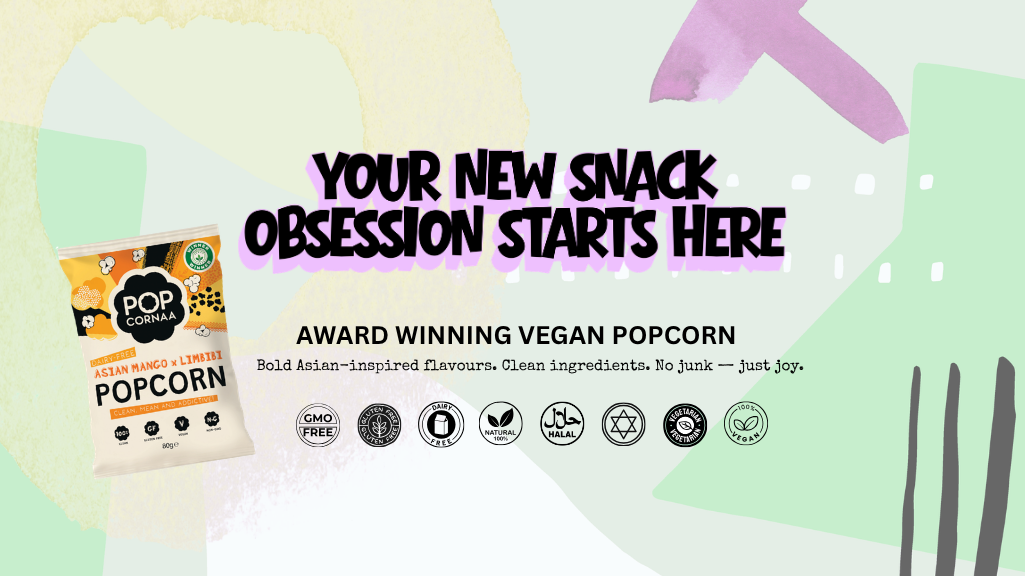
All our popcorn is vegan, with Asian-inspired and British flavours. If you are new to us, the Newbie Asian Fusion Taster Box has five bags for £17.99. For something sweeter, the Asian Sweet Bliss Box has nine bags for £25.95, and the Ultimate Asian Sampler Box has twelve for £32.95.
[ ](https://www.popcornaa.com › pages › asian-fusion-taster-box)
Buying for someone else? Our digital gift cards start from £10, and you can build your own snack mix. For offices, shops and events, our wholesale page covers snack bags and bulk sharing bags.
How to choose a natural popcorn, step by step
Whether you are buying kernels, ready-popped bags or a gift, the same checks apply.
Start with the front, then turn the bag over. The front tells you what the brand wants you to feel. The back tells you what is in it.
Match the claim to the proof. If a bag says organic, look for the certifier’s code. If it says vegan, look for the symbol or a clean ingredients list. If it says natural, read every ingredient and decide whether you are happy with it.

Think about the occasion. Movie night with the family calls for a big bowl of something simple. A work snack drawer might suit single-serve bags. A gift can be more playful.
Pick a portion. Aim for 25 to 30g as an everyday snack. Our guide to healthy snacking and a popcorn tip shows how it can fit into a day.
Check again later. Recipes change. A quick look at the pack every so often costs you nothing.
FAQ
Is all natural popcorn healthy?
Plain popcorn is a whole grain with fibre, and a portion of about 25 to 30g is a light snack. The word “natural” itself says little about health, because sugar and salt are natural too. Look at the ingredients and nutrition panel, and treat sweeter or heavily seasoned versions as an occasional pleasure.
Does natural popcorn mean organic?
No. In Great Britain, organic is a certified claim that requires approved control body certification and a code on the label. Natural is a general description without that certification. A bag can be natural, organic, both or neither, so check each claim separately.
Is natural popcorn always vegan?
No. A recipe can be free of artificial additives and still use butter, milk or whey. Check the ingredients and allergen statement, and look again if a familiar product gets a new look, since recipes do change.
Can I make natural popcorn without oil?
Yes. Air-popping needs no oil, and you can season the popcorn afterwards with herbs, spices or a little salt. Our air-popped guide explains the method.
Sources
- What Does ‘Natural’ Actually Mean On Food Labels? (Food Network)
- All Natural Label Claim: What FDA and USDA Allow (TaroStack)
- Criteria for the use of the terms fresh, pure, natural (Food Standards Agency)
- The Trouble With ‘Natural’ and ‘All Natural’ (Consumer Reports)
- Don’t Be Duped by Misleading Package Labeling (Tufts Health & Nutrition Letter)
- A Popcorn Primer (popcorn.org)
- What the Heck Is in Movie Theater Popcorn? (HowStuffWorks)
- Skinny Pop Microwave Popcorn Just Stopped Being Vegan (Sporked)
- Organic Food (IFST)
- Soil Association Organic Standards for Great Britain
- Regulation (EU) 2018/848 and NI impacts (UK government)
- Labeling Organic Products (USDA AMS)
- More On Interpreting Food Certification Labels (ACSH)
- Is popcorn healthy? (BBC Good Food)
- Nutrition (popcorn.org)
- Is Popcorn Healthy? (TODAY)
- The Best Stovetop Popcorn Recipe (A Hopeful Home)