

Three craft popcorn brand differences that change how popcorn tastes
Craft popcorn is small-batch, ingredient-led popcorn made with real oils, whole sugars, and hand or tumble coating rather than industrial spray-on flavourings. It appeals because it tastes like something a person actually made, not a factory line: the flavour is deeper, the texture holds up, and the packaging usually tells you what’s inside instead of hiding behind marketing gloss. Brands such as Popcornaa build entire ranges around this idea, pairing single-origin kernels with distinct flavour stories rather than one generic “cheese and toffee” tub.
TL;DR:
- Genuinely craft popcorn is made in small batches with transparent ingredients and often features limited-edition flavors that tell a story.
- The type of kernel used, either mushroom or butterfly, significantly impacts texture and suitability for different flavors.
- Tumble-coating during production creates deeper flavor adhesion and a crunch that lasts longer than spray-coating, which produces a uniform gloss.
- Authentic craft brands disclose kernel origin, use named oils and sugars, and avoid artificial preservatives, justifying higher prices.
- Packaging choices like resealable pouches and gift boxes signal quality, and ingredient lists with named oils and sugars help identify true craft products.
Explaining craft popcorn brands: what ‘craft’ actually means
“Craft” gets thrown around loosely in snack aisles, so it helps to pin down what actually separates a craft popcorn brand from a supermarket own-label bag. The term borrows from craft brewing and craft baking: small production runs, visible technique, and a maker willing to put their name behind the recipe.
Three things tend to define it in practice.
- Small-batch production. Kettle-popped or drum-tumbled in limited runs rather than continuous industrial extrusion, which means more control over how evenly a coating sets and how consistently kernels pop.
- Ingredient transparency. Craft producers list actual oils (often coconut or rapeseed, chosen for a high smoke point), real cane sugar rather than glucose syrup blends, and sometimes name the kernel’s growing region.
- Storytelling and limited editions. Craft brands treat flavours like seasonal menus. A Sichuan chilli caramel or a matcha white chocolate batch might run for a few months, then disappear, which builds the kind of collectability a permanent supermarket SKU never will.
These choices show up on the tongue, not just the label. Kettle-cooked batches tend to have a rougher, more textured coating because the sugar caramelises unevenly across each kernel, while mass-produced spray coatings sit as a thin, uniform film. That unevenness is often the tell that you’re eating something made in smaller quantities. For a deeper look at how these production choices reshape flavour, Popcornaa’s guide to what makes popcorn gourmet breaks down the technical side further.
How craft brands differ in ingredients and production
The biggest practical difference between a craft bag and a mass-market one comes down to three decisions: which kernel, which fat, and how the flavour gets onto the corn.
Kernel type shapes texture before flavour even enters the picture. Mushroom kernels pop into round, dense, compact puffs that hold their shape under a heavy caramel or chocolate coating, which is why you’ll see them favoured for indulgent, coated flavours. Butterfly kernels pop into the classic irregular, wing-shaped puff with more surface area and a lighter, airier bite, better suited to simple salted or savoury profiles where you want crunch without density. Craft brands pick deliberately between the two rather than defaulting to whichever is cheapest to source, a distinction covered in more manufacturing detail on MadeHow’s overview of popcorn production.
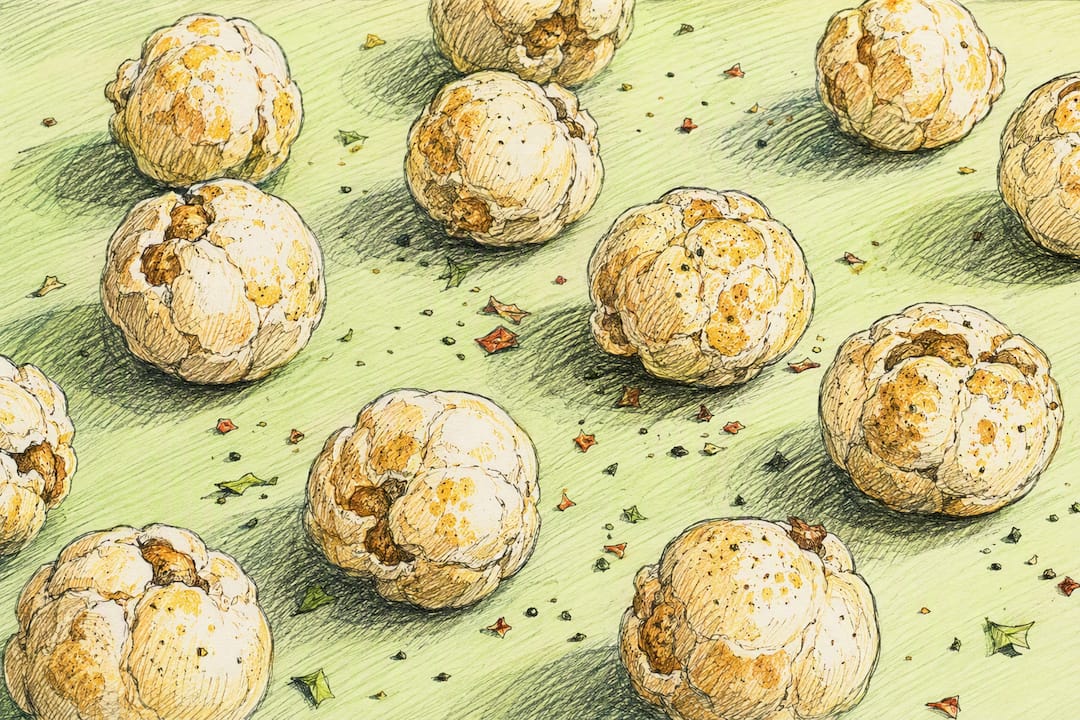
Fat and sweetener choices change mouthfeel and aftertaste more than most people expect. A coconut oil base gives a cleaner finish than a generic vegetable oil blend, and real cane sugar caramelises with a rounder, less cloying sweetness than glucose syrup. These are small line items on an ingredient panel that make a noticeable difference by the third handful.
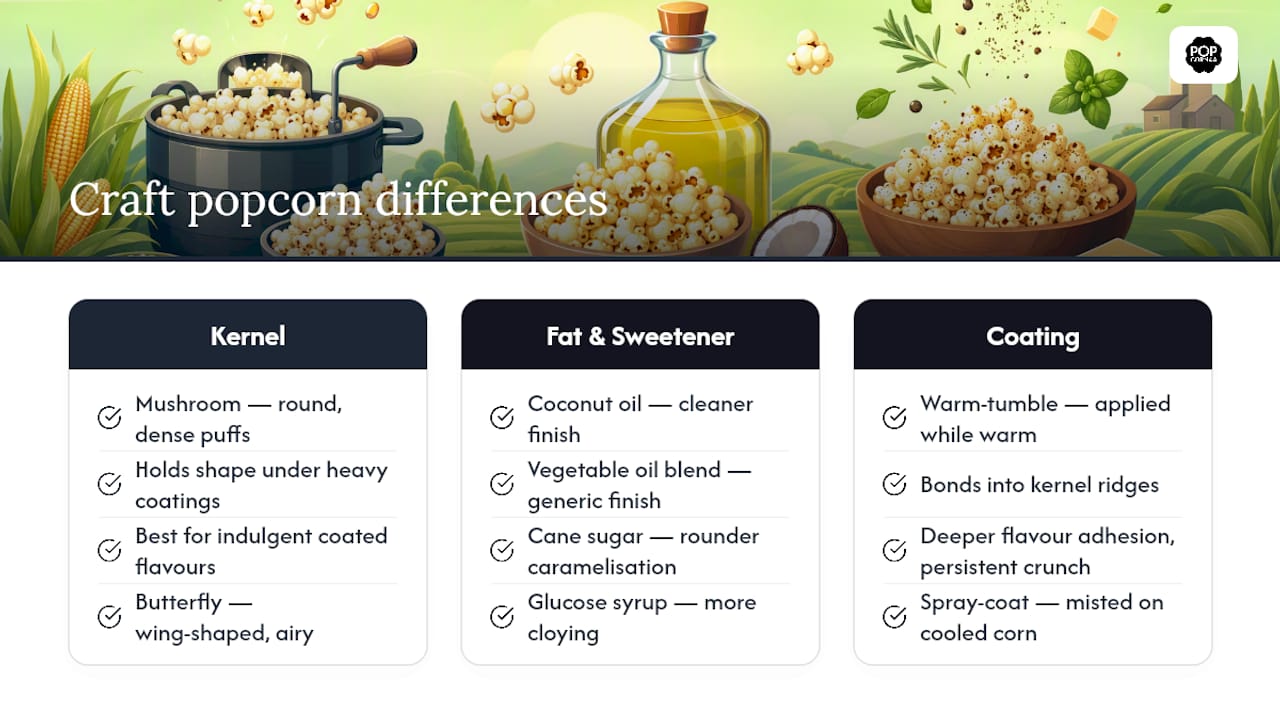
Coating method is where the real production split happens. Industrial popcorn is usually spray-coated: flavouring is misted onto cooled kernels from a nozzle, which is fast and cheap but sits on the surface. Craft producers more often tumble-coat while the corn is still warm, letting sugar or seasoning bond into the kernel’s ridges rather than just dusting the outside. That warm-tumble method tends to produce deeper flavour adhesion and a more persistent crunch, which is one reason a craft bag can taste “more flavoured” for longer, right down to the last handful.
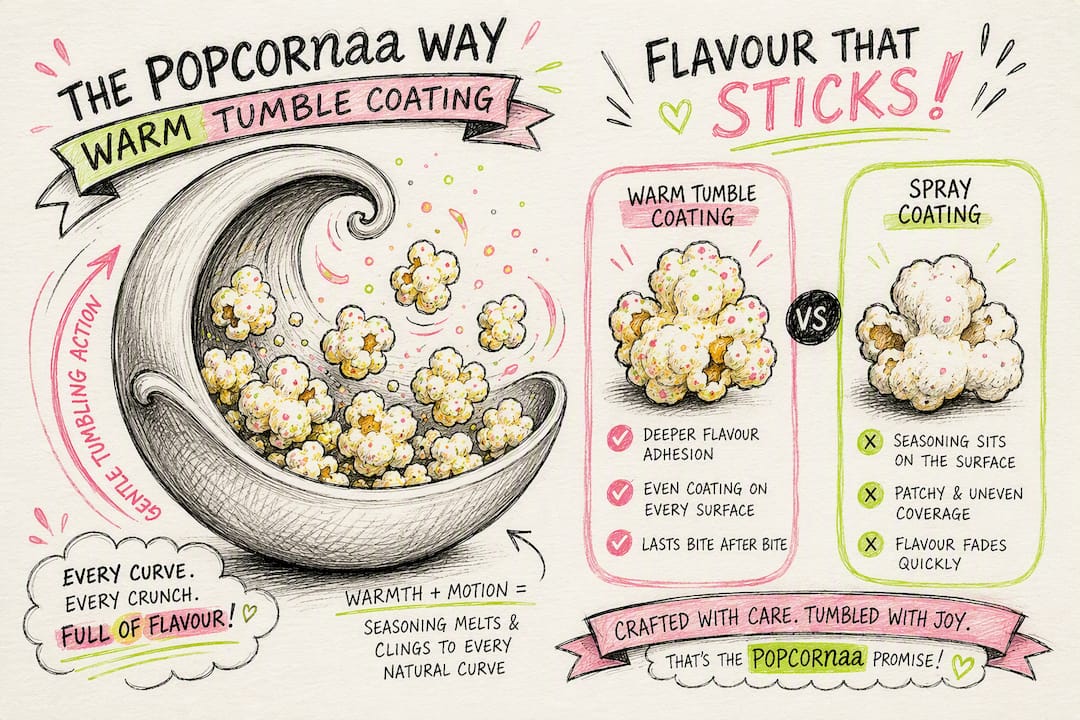
Pro Tip: If a bag looks glossy and perfectly uniform on every piece, it was almost certainly spray-coated. Craft batches usually show slight unevenness, a visual cue that the coating was tumbled on by hand.
Small-batch production generally costs more per kilogram since it processes lower volumes per batch than industrial lines. That cost difference is the honest explanation behind craft popcorn’s higher price point, rather than pure markup.
Flavour development and packaging as brand storytelling
Craft popcorn brands treat flavour and packaging as one continuous idea rather than two separate departments. A flavour without a story is just seasoning; a story without good popcorn underneath is just marketing. The brands that get both right are the ones people buy again.
- Themed flavour drops. Many craft producers release flavours tied to a season, a place, or a cultural reference point, whether that’s a British seaside toffee or an Asian-inspired yuzu chilli mix, rather than a static permanent menu.
- Limited editions build collectability. A flavour that only exists for a few months creates a reason to come back and check what’s new, which is a large part of why craft snack coverage keeps circling back to storytelling as a category driver, as one recent interview on a gourmet popcorn brand’s approach makes clear.
- Packaging signals quality before the bag is even open. Resealable pouches, matte finishes, and gift-ready boxes are not just aesthetics. They tell you whether a brand expects you to eat the whole bag in one sitting or savour it over a week.
- Label claims should map to the actual flavour. If a bag says vegan, organic, or allergen-free, that claim should line up with the ingredient list on the back, not just the front-of-pack branding.
Packaging has become a genuine differentiator in this category, not an afterthought, and food industry coverage of narrative-led snack brands backs that up: presentation is increasingly treated as part of the product itself, as Feast Magazine’s piece on popcorn’s craft moment describes. If you want to see how packaging choices translate into practical decisions, Popcornaa’s notes on gourmet popcorn packaging cover what materials actually keep a bag fresh versus what’s there purely for shelf appeal.
How to evaluate craft popcorn before you buy
You don’t need to be a food scientist to spot a genuinely craft bag on a shelf or a webpage. A short checklist does most of the work.
- Read the ingredient list first, not the front of the pack. Real oils, named sugars, and a short list overall are good signs; long chains of E-numbers usually aren’t.
- Look for production language. Terms like “small-batch,” “kettle-cooked,” or “hand-tumbled” usually indicate a genuine process change, not just marketing flourish, though it’s worth checking they appear alongside a proper ingredient list too.
- Match kernel type to texture expectations. If a product photo shows dense round puffs under a thick caramel shell, that’s mushroom kernel; airy irregular pieces point to butterfly.
- Think about portion and packaging for the occasion. A large sharing bucket suits a movie night; a smaller, well-presented box suits a gift.
- Compare price against ingredient quality, not price alone. A £6 bag with named oils and a two-month shelf life is a fundamentally different product from a £2 bag padded with preservatives, even if they look similar in the photo.
Pro Tip: Check the sugar listed first on the ingredient panel. If it says “glucose syrup” rather than “cane sugar,” the coating was almost certainly built for shelf stability over flavour depth.
Sourcing statements matter too. Brands that name where their kernels come from, or specify non-GMO status, are usually the same ones willing to be transparent about the rest of the process. Popcornaa’s explainer on non-GMO popcorn is a useful reference if you want to understand what that label should and shouldn’t promise you.
Popular craft styles and kernel varieties mapped to eating experience
Matching a kernel type to what you actually want from a snack saves you from buying the wrong texture twice.
- Mushroom kernel: dense, round, sturdy puffs built to carry heavy caramel, chocolate, or thick savoury coatings without collapsing.
- Butterfly kernel: lighter, airier, classic wing-shaped puffs that suit simple salted, buttery, or delicate seasoning profiles.
- Caramel and salted caramel hybrids: among the most common craft profiles, balancing sweetness against a savoury edge, usually built on mushroom kernels for structural support.
- Cheese-forward savoury blends: typically butterfly-based, relying on nutritional yeast or plant-based cheese powders in vegan versions to hit that umami note without dairy.
- Spicy and fusion flavours: increasingly common as craft brands borrow from global cuisines, from Korean gochujang to British curry spice blends.
- Vegan-friendly technical swaps: plant-based binders like rice syrup or coconut nectar replace dairy butter, which changes the coating’s set but can still deliver a rich mouthfeel when done properly.
If vegan formulation is a priority for you, Popcornaa’s guide to vegan gourmet popcorn explains which fat and binder swaps hold up best against traditional butter-based coatings.
Market trends shaping craft popcorn right now
Supermarket private-label popcorn is getting better, and that’s actually good news for craft brands rather than a threat. As own-label ranges push for higher-quality bulk kernels, private-label penetration in the UK popcorn segment is expected to rise, which is pressuring even budget producers to shift toward non-GMO, organic, and lower-sodium ingredient standards.
That shift raises the baseline for the whole category, which paradoxically makes genuine craft claims more valuable, since “real ingredients” stops being a differentiator and starts being an expectation everyone has to meet.
At the same time, ready-to-eat and premium popcorn segments are growing more rapidly than other parts of the category, with consumer preference tilting toward vegan and flavour-innovative options rather than plain salted or sweet basics. For small-batch producers, that growth means more room to charge for genuine quality rather than competing purely on shelf price against supermarket own-brand.
PopCornaa’s approach to craft popcorn
Popcornaa builds its range around the same craft principles covered above: vegan formulations, Asian-inspired and British flavour pairings, and small-batch attention rather than one-size-fits-all seasoning.
A few concrete proof points worth knowing:
- Popcornaa’s flavour ranges are organised into curated collections with distinct themes, including Asian-inspired and British flavour pairings, rather than a single undifferentiated product line.
- The brand’s Great Taste Awards recognition reflects external validation of flavour quality, not just self-reported claims.
- Product formats span themed gift boxes, sharing buckets, and customisable snack mixes, suitable for gifting and everyday snacking.
- Popcornaa’s own blog content, including its guide to gourmet popcorn flavours, goes further into the technical side for readers who want it.
Why craft popcorn is worth the extra attention
Craft popcorn earns its place in a snack cupboard because it rewards attention rather than punishing it. The more closely you look at a bag, the ingredient list, the coating method, the kernel choice, the more the price difference against a supermarket own-label makes sense. That’s a rare thing in snack food, where most premium pricing is really just packaging design and a brand name doing the heavy lifting.
What gets underestimated, though, is how much kernel selection alone changes the experience. Most shoppers focus entirely on flavour names, chilli caramel versus salted toffee, without realising that a mushroom kernel under a thick coating and a butterfly kernel under a light dusting are almost different snacks entirely. Understanding that distinction is arguably more useful than reading a hundred flavour reviews.
If you’re new to exploring this category, Popcornaa’s flavour quiz and curated sets are a reasonable starting point for working out which kernel and flavour direction actually suits your palate, rather than guessing from packaging alone.
— Emily
Ready to try craft popcorn for yourself?
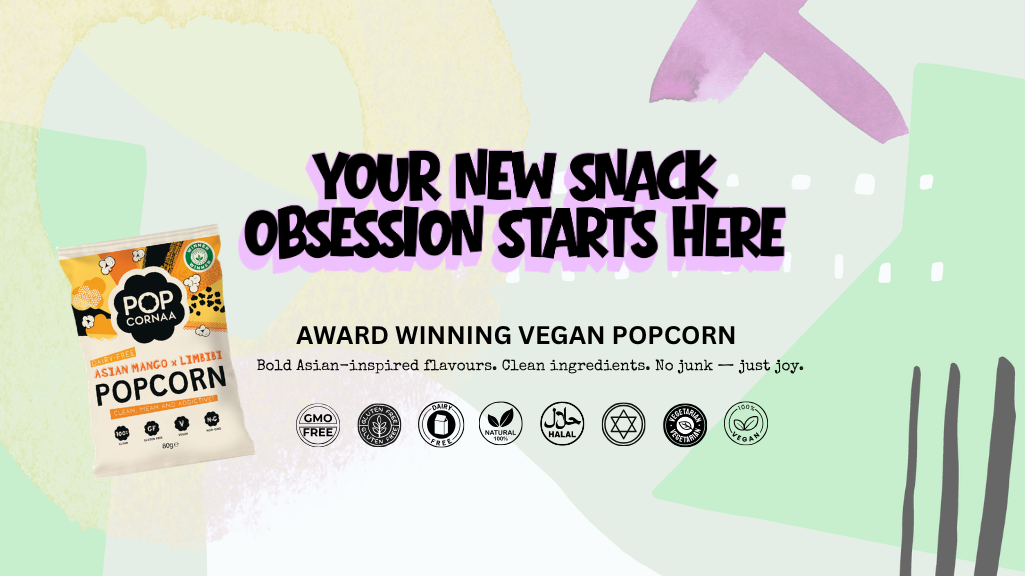
Popcornaa is a direct route into everything this article has covered: small-batch, vegan-friendly popcorn built around real ingredients and genuinely distinct flavour ranges, rather than a single generic tub trying to please everyone. Where supermarket own-label is chasing acceptable, Popcornaa is chasing memorable, backed by external recognition through its Great Taste Awards rather than self-assigned marketing labels.
[ ](https://www.popcornaa.com › pages › asian-fusion-taster-box)
For a gift, the themed boxes under Brit-Core Flavourz or Our Asian Flavourz do the storytelling work this article described, arriving pre-curated rather than needing you to guess which flavours pair well together. For daily snacking, the sharing buckets and customisable mixes let you build around a kernel and coating style you already know you like. Head to Popcornaa’s site to browse the current flavour collections and put together your first order.
Sources
For readers who want the primary data behind the market claims in this article, IndexBox’s UK bulk popcorn market analysis and Deep Market Insights’ UK popcorn market report cover private-label growth and premium segment trends in more depth. Wikipedia’s list of popcorn brands offers broader category context, and Wild Foodz’s 2026 gastronomy trends piece is useful background on the wider culinary storytelling trend craft snacks are riding.
- Popcorn bulk market in the United Kingdom | IndexBox
- United Kingdom popcorn market — Deep Market Insights
FAQ
What are the different types of popcorn brands?
Popcorn brands generally split into three tiers: mass-market industrial brands using spray-coating and bulk kernels, supermarket private-label ranges sitting between budget and mid-tier quality, and craft or artisanal brands using small-batch production, tumble-coating, and named ingredient sourcing.
What makes a popcorn brand genuinely craft rather than just marketed as premium?
Genuine craft brands disclose kernel type, use named oils and real sugars rather than glucose syrup blends, and typically use small-batch kettle or tumble methods rather than continuous industrial lines.
Does the popcorn kernel type actually matter?
Yes. Mushroom kernels pop dense and round, holding heavy coatings well, while butterfly kernels pop lighter and airier, suiting simple savoury or salted flavours, so the kernel choice directly shapes the eating experience.
How do I judge popcorn quality when buying online?
Check the ingredient list for named oils and sugars, look for production language like “small-batch” or “hand-tumbled,” and compare price against ingredient quality rather than price alone.
Are vegan and non-GMO claims common in craft popcorn?
Increasingly so. Growing consumer demand for vegan, organic, and lower-sodium options has pushed many craft producers, including brands like Popcornaa, to build entire ranges around plant-based formulations.